

CHUNKS DANCE
EMOTIONIFICATION: Create three points of resonance where movement, sound, and emotion come together.
CC experience (MN#83)

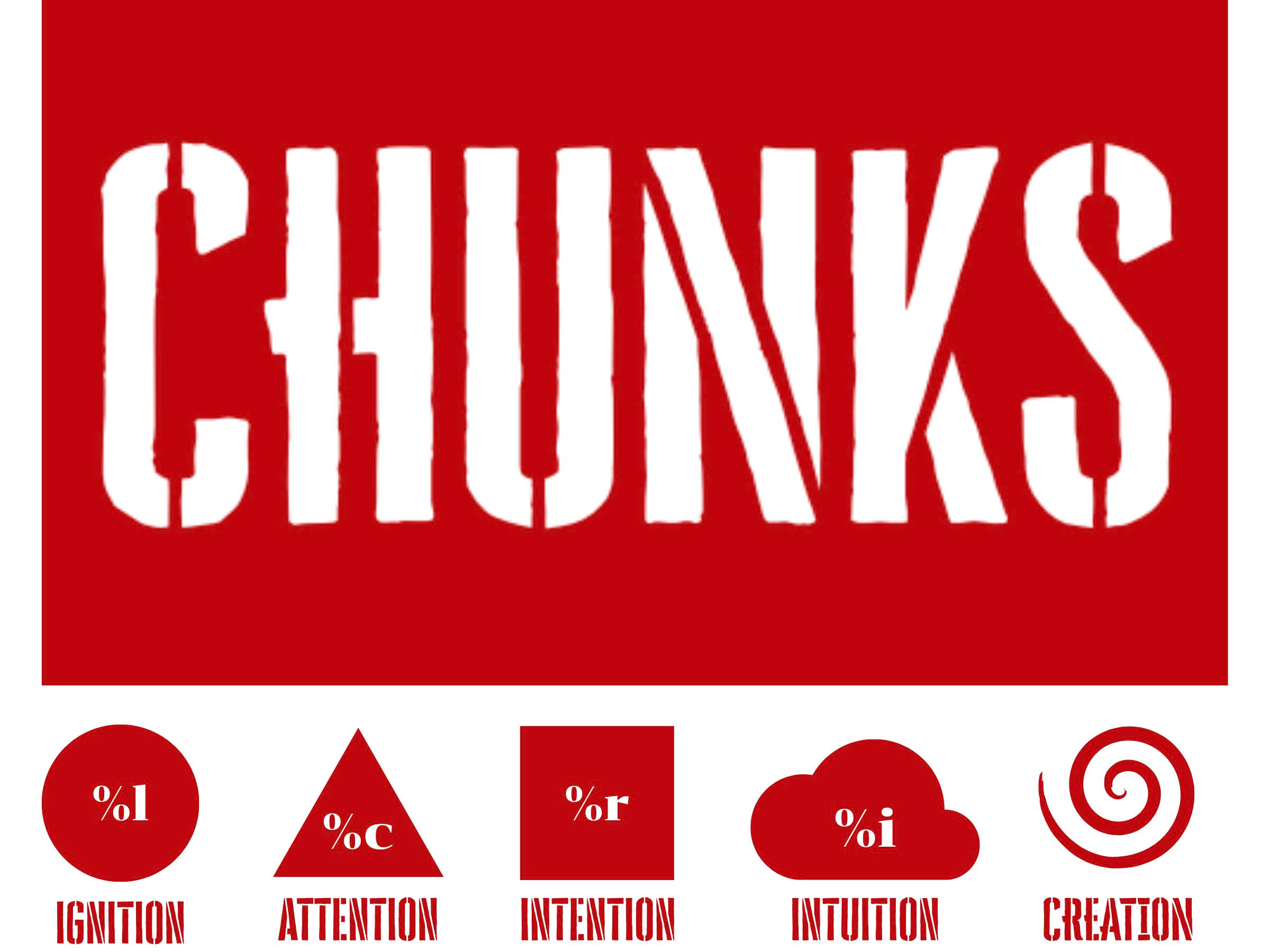

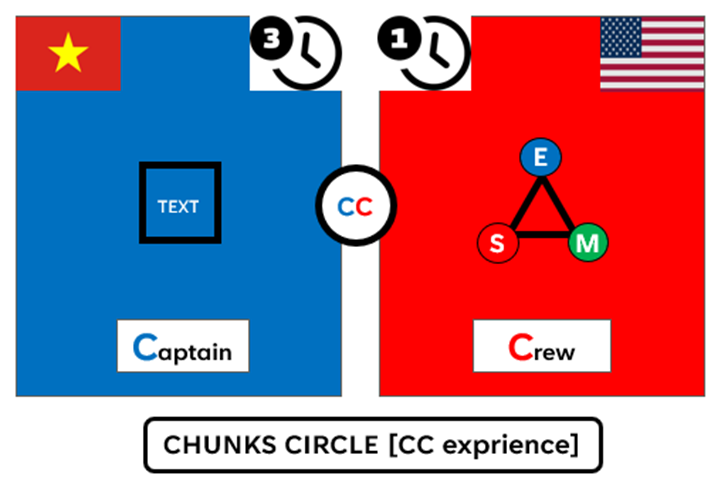
In Chunks Circle (CC), learners face two “C’s”—two linguistic fear systems that battle each other in a timed game:
- Blue C = Captain: text-based linguistic fear (grammar, rules, social correctness, “what should I say?”).
- Red C = Crew: MSE-based fear (self-expression, sounding/looking “too much,” leaving comfort zone, “can I embody this?”).
Roles & Setup
- 1 in-charge Chunker (judge/coach): keeps the game moving, fixes grammar after the attempt, and protects CC’s rule: MSE over text.
- Many students rotate turns under strict time pressure.
Each round uses:
- 1 keyword (content anchor)
- 1 of 108 MSE nuance hints (the “how” — motion/sound/eye pattern)
The Round (Time-Constraint Battle)
1. Blue Captain (3 seconds): Vietnamese improv
- Given the keyword + MSE nuance hint, the Captain must instantly improvise a Vietnamese sentence within 3 seconds.
- This attacks text/rule fear by forcing fast choice and killing overthinking.
2. Red Crew (next 1 second): English transfer + exact MSE clone
- Immediately after, the Crew must say the same sentence in English.
- The trick: the Crew must reproduce the Captain’s MSE exactly:
body motion
sound/audial nuance (pitch, pace, stretch, rhythm)
eye movement / gaze behavior
- Grammar is not the main concern; the Chunker will correct it afterward. The main score is MSE fidelity under pressure.
Win Conditions
- Captain loses if they break the 3-second limit (freeze/overthink = blue fear wins).
- Crew wins the round if they deliver the English line within the time limit and match the Captain’s MSE closely.
- If the Captain loses by time, roles swap (the system punishes freeze and rewards flow).
What CC Trains (the real purpose)
CC dissolves two fear types simultaneously:
- Blue Captain role dissolves text-based fear
→ faster improvisation, less grammar/social-rule paralysis, more decisive language choice.
- Red Crew role dissolves MSE-based fear
→ stronger self-expression, better embodiment, less comfort-zone hiding, more RPD-free delivery.
Unlike EE (v1.1) where text is central and MSE supports, CC makes MSE central and text secondary—with the Chunker acting as the grammar safety net so learners can stay bold, fast, and embodied.
2-PILL DILEMMA INSIDE CHUNKS CIRCLE (CC) – RED DRIVE VS BLUE DRIVE
Effect: Blue drive creates freeze, delay, and ego-lock—RPD appears.
CC is basically a drive-selection machine:
Red drive trains MSE and produces RPD-free flow.
Blue drive collapses MSE and produces freeze.
So, CC doesn’t mainly “teach English.” It teaches the learner to choose Red under pressure—using the group format, stakes, and attention design—until MSE resonance becomes stable and automatic.
CHUNKS SHADOW WORK – THE GOOD FEAR
In CHUNKS, life can be seen as a fear-lab: endless obstacles keep appearing, and each obstacle tests a different “devil mask” of fear—failure, rejection, shame, uncertainty, loss, temptation. Most of these are external shadows: they multiply forever and can’t be permanently defeated by logic, avoidance, or wishful positivity.
CHUNKS flips the problem by identifying one fear that is not only real, but trainable: the inner shadow—your personal Lucifer / Sun Wukong / inner dragon. This “monster” is not meant to be killed. It exists to protect the soul’s integrity, but it becomes destructive when it is suppressed, denied, or fought directly. The moment you try to “erase” it, it turns into sabotage; the moment you try to “worship” it, it turns into possession. So, the correct goal is not to defeat the monster—it is to train the master.
That is why CHUNKS calls it the Good Fear: the highest fear is not fear of obstacles; it is the fear of losing yourself, aka losing self-regulation—losing the steering wheel of your own Motion–Sound–Emotion system. This root fear becomes sacred when it points you back to authorship: “I must stay regulated; I must stay coherent.” When this fear is trained, it becomes the engine of inner discipline and the guardian of integrity.
The core claim is simple and absolute:
MSE-regulation training seems to be the only workable method to train the inner monster.
No debate with the shadow works long-term without regulation. No suppression works. No intellectual insight alone can command it. Only repeated MSE training—breath control, tone control, timing control, posture and micro-movement control, emotional containment without flooding—gradually produces real authority.
In practice, CHUNKS uses a principle similar to Sun Wukong’s headband: a compassionate constraint loop—a “loving control seal.” Not punishment, not violence—just consistent boundaries applied through MSE. The message is: “I’m not limiting you to harm you. I’m guiding you because I love you, and because we’re one system.” When the shadow repeatedly experiences this calm, firm, non-harming governance, it begins to trust the master. Obedience grows—not by fear of punishment, but by certainty of unconditional care.
Over time, your inner monster stops being your enemy and becomes your protector-energy: the dragon that can be deployed against the many external shadows. You don’t wish for an obstacle-free life. You wish for a trained inner guardian strong enough to face any obstacle without losing coherence.
So, CHUNKS shadow work is not “fighting darkness.” It is raising a loyal darkness into disciplined light—through MSE regulation alone—until the Good Fear becomes your strongest friend and your most reliable weapon against life’s temptations and fears.
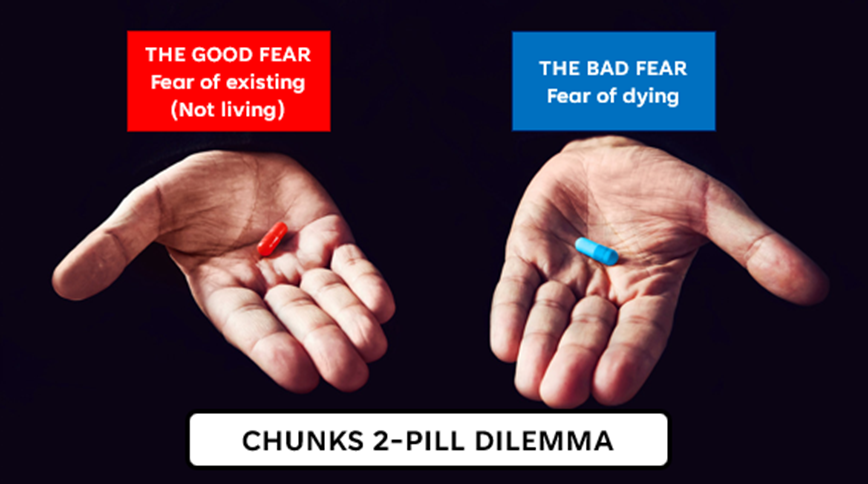
CHUNKS frames shadow work as a lifelong choice between two fundamental fears—two “monsters”—like the Matrix **blue vs. red pill.
Blue Pill = Fear A: fear of dying (ending the current version).
This fear protects the existing self: it avoids risk, clings to comfort, and accepts the current situation—even if it’s small or illusion-based—because losing the present identity feels like death.
Red Pill = Fear B: fear of “not living” (continuing to exist in illusion).
This fear rejects an unreal, mission-free, potential-suppressed life. It is the fear of staying un-authored—alive but untrue.
CHUNKS’ strategy is not to eliminate fear, but to train which fear becomes stronger.
Through MSE-regulation drills (Motion–Sound–Emotion authorship), the master is trained first—breath, voice, body, and emotion become governable under pressure. As regulation stabilizes, Fear B naturally grows into a disciplined guardian—strong enough to override Fear A.
Result: when Fear B wins, the person chooses truth, mission, and higher potential even at the cost of the current version; when Fear A wins, the person chooses safety and keeps the illusion intact.
Why “2-Step Training Self-Authorship” Comes From the CHUNKS Choice Dilemma (2 Steps)?
Step 1 — Freedom of Choice → Train Self-Authorship (MSE Regulation First)
The CHUNKS choice dilemma begins with a hard truth: without MSE-regulation, “choice” is mostly reaction (fear, comfort, social pressure, impulse). Therefore, the first necessary step is to train self-authorship—Motion–Sound–Emotion control—so the person gains a full range of conscious choice.
So: Freedom of choice is impossible without training the master first.
Step 2 — Choice of Passion → Train the Inner Shadow (Good Fear Grows Automatically)
Once freedom becomes real, the dilemma flips: now the person can choose the best-fit passion/suffering (mission-aligned burden). This choice instantly amplifies the Good Fear—fear of “not living,” fear of losing self-regulation, fear of losing the destined mission. That growing Good Fear is exactly the inner shadow/monster becoming stronger and more loyal.
So: Training the shadow is not a separate technique; it is the automatic outcome of authored passion-choice.
Conclusion: CHUNKS’ two-step training is identical to the two-step choice dilemma:
(1) Freedom requires MSE self-authorship → (2) Passion-choice makes the Good Fear grow, which trains the inner shadow.
Power precedes mercy.
Not power over others—power over your own MSE.
Only when you can win over its power (stay regulated under its pressure) does the shadow finally conclude:
“If you can control me, but you still choose compassion… then your love is real.”
That’s when self-love stops being a slogan and becomes a governance-relationship:
- firm boundary (command),
- steady regulation (proof),
- then unconditional care (mercy).
If the host is weaker than the shadow (low MSE control), “self-love” talk can become:
- excuse-making (“I’m healing”),
- permission to stay unregulated,
- spiritual bypassing,
- or even a trap that strengthens the monster’s rule.
Because the monster will keep escalating tests until either:
1. the master proves authorship, or
2. the master collapses and calls it “self-love.”
In CHUNKS, self-love without MSE authorship is not love—it’s a negotiation with the shadow, and negotiations are exactly how the shadow stays in charge.
“Can” has two meanings that people mix up:
- Can = ability (I’m capable of doing X).
- Can = likelihood (If I can, I probably will / I must want to).
When these get fused, the mind concludes:
“If I can do harm, I will do harm.”
“If I can do something, it means I should / I want to.”
That collapse destroys self-authorship, because ability becomes destiny. The person stops trusting themselves.
CHUNKS fix: MSE regulation creates a firewall between capacity and choice:
“Yes, I can. And I can also not do it.”
That firewall is the origin of real freedom.
Judgment is a symptom of low can-range under weak authorship. We judge others for what we cannot allow ourselves to do (without losing MSE authorship).
People judge because they fear: “If I allowed that possibility in myself, I’d lose control.”
So judgment becomes a substitute for regulation.
Why This Is the Origin of Self-Belief (Confidence)?
True confidence is not “I’m good.” It is:
I can allow many possibilities because I trust my authorship to choose well.
At high MSE authorship, a person can even choose sacrifice—override shadow-benefit for a higher value. That proves inner authority, and judgment drops naturally.
Why Self-Judgment Is the Root of Inferiority?
Inferiority is basically self-judgment turned inward:
- “I shouldn’t be like this.”
- “If I can do wrong, I will be wrong.”
- “I can’t trust myself.”
So, the deepest confidence upgrade is not motivation—it’s regulation:
MSE drills → expanded can-range → stable authorship → less self-judgment → less judgment of others → real confidence (self-belief).
CHUNKS Law of Absoluteness: In a universe where everything is relative and can be challenged by exceptions, the only immediately validable certainty is present-moment self-authority—your ability to choose and steer your next MSE vector. The purest form of that authorship is unconditional love: action without demand, not as a claim about the world, but as a directly enactable act.
1) The Disqualification Test (Reality)
Every belief “works” until Reality applies a simple test:
- Show an immediate exception, or
- Demand proof right now.
Most beliefs fail because they are beliefs-about-the-world (propositional claims). The world can always present counterexamples, uncertainty, delay, or contradictory evidence. So, these beliefs remain meaningful, but they are not exception-proof in the present moment.
2) Two Layers of Belief
Layer A — Propositional belief (claims about reality):
“I’m protected.” “Love wins.” “The future will be okay.”
These can be challenged instantly by exceptions or lack of immediate proof.
Layer B — Operational belief (authorship you can enact now):
“I can choose my next action.”
“I can re-enter MSE regulation now.”
Operational belief is not a claim about the reality—it is capacity + commitment that can be demonstrated immediately.
People often think they believe in X, but the hidden wish is:
“If I believe in X strongly enough, I’ll finally believe I can handle myself.”
So, the mind uses God/love/future/success as proxies for the real desire: self-trust under pressure. CHUNKS calls that out and returns belief to its only reliable core: self-command through MSE.
3) The Only Non-Disqualifiable Belief
Under the strict definition of belief—workable, logical, provable-now, exception-resistant—only one belief survives:
Self-authority (self-authorship): the next-moment ability to choose and steer MSE (Motion–Sound–Emotion/eye), within available physical capacity.
Reality can disturb conditions (pain, fear, fatigue), but it cannot refute authorship the way it refutes claims. It can only disable capacity (coma, seizure, total physical shutdown). That’s not disqualification by exception; that’s the system going offline.
Seal: Belief-as-claim can be disproved by the world; belief-as-authorship can only be disabled, not refuted.
4) “Wearable” Belief
“Wearable” means you can put it on in the next 10 seconds.
MSE regulation is wearable because you can demonstrate it now:
- shift breath and posture,
- steer eyes/attention,
- reshape sound wave patterns (tone, rhythm, pressure),
- use intentional micro-motions—hand gestures, stance shifts, grounded posture changes—to steer state.
Abstract beliefs are often unwearable by themselves: they become wearable only when the MSE instrument is trained.
5) The Hidden Trick Behind “Miracle Rules”
Many “miracle-like” systems (manifestation, NLP, destiny laws) assume belief is the precondition. But most people only have verbal belief (a sentence they can say), not authentic belief (a capacity that holds under pressure). So the method fails at the precondition.
CHUNKS exposes the trick:
If belief is required, then belief itself must be audited.
The only authentic belief is self-authority.
Once self-authority is online, alignment effects appear “miraculous” because the real requirement—state control + consistency—finally exists. It doesn’t force the reality to comply; it stops you from breaking your own vector.
6) The “Self-Control” Misconception
People hear “self-control” and assume restriction: suppress emotion, stay calm, act disciplined.
CHUNKS is the opposite: self-freedom (state sovereignty).
Not “calm forever,” but range + steering: enter calm when needed, enter power when chosen, exit chaos without suppression.
Freedom isn’t doing anything you want.
Freedom is being able to do what you choose—even when emotion, fear, or habit tries to drive.
And only after real freedom becomes possible can one truly select a stable passion/mission—otherwise “passion” is often a trauma-loop, compensation, or identity theater.
7) Not Stoicism (Even If It Looks Like It)
From outside, CHUNKS self-regulation can resemble Stoicism, but the engine is different:
- Stoicism tends to govern self through reasoned judgment and explanation (“I shouldn’t be angry because…”).
- CHUNKS governs self through trained state-control and embodied command (“Downshift now.”).
In CHUNKS, explanation is optional. Belief becomes real when the body obeys chosen direction without needing a convincing story.
Final Node Statement
In a world of relativity, the only technically absolute belief is self-authority: the present-moment authorship of your next MSE choice. All other beliefs either depend on the world (and can be disqualified) or function as symbols that help you return to the only belief that cannot be refuted—only disabled.
Most abstract beliefs are unreal in practice because they can’t be validated or trained on demand—Mr. Universe can always demand proof or show an exception. The only belief that survives as validable + practiceable is self-authority: your next-moment ability to choose and steer MSE (Motion–Sound–Emotion/eye), within physical limits. That’s why this insight opens the CHUNKS door: belief is no longer a slogan—it becomes a drillable skill, because MSE-regulation is genuinely trainable in real time.
Therefore, self-belief is earned confidence: the proven ability to re-enter self-authority and steer MSE in the next moment while psychological self-suggestion seems to be borrowed confidence: words that feel strong until pressure arrives and your state can’t obey.
CC’s transformation engine has two complementary parts. One part reduces resistance so the identity-guard can’t fully activate; the other part builds authorship power so the learner can actually command MSE on demand. Together they increase the probability of real identity change.
Core idea
- Rule of 1 Second = lowest possible resistance (the guard is down).
- Book of CC / SPL (Self-Prom Logger) = highest possible initiative (the author attacks on purpose).
Comparison Table
Aspect | Rule of 1 Second | Book of CC (Self-Prom Logger / SPL) |
|---|---|---|
Primary function | Lower identity-defense resistance | Increase self-authorship power |
What it targets | The guard of the shadow (identity protection, overthinking boot-up) | The master of the system (ability to command body/MSE) |
Core mechanism | Time compression: speak/move within 1 second before “who I am” loads | Self-promise wins: “Now I will do X” → do X → log it |
Main fear it bypasses | Fear of breaking current MSE identity (“I’m not that version”) + grammar paralysis | Fear of self-betrayal / low self-credit (“I can’t trust myself”) |
What it guarantees | Resistance is minimized (low friction window) | Initiative is trained (authored action becomes reliable) |
What it does not guarantee | It doesn’t prove the learner can command MSE—only that the gate is open | It doesn’t automatically lower live social resistance—only builds inner command over time |
Time scale | Real-time (in-the-moment performance) | Daily practice (long-term credit accumulation) |
Output signal | Snap start, fast entry into MSE mimic mode | Rising self-credit, higher consistency, stronger “I can command myself” |
Role in CC game | Creates the entry window for MSE resonance and imitation | Creates the training history that makes entry reliable |
Metaphor | Lower the wall | Train the climber |
Combined System (why both are needed)
- Rule of 1 Second makes the identity-defense wall temporarily low — but a low wall doesn’t guarantee the learner can cross it.
- SPL / Book of CC trains the learner to take initiative against their own shadow and rebuild self-credit through repeated wins — so when the wall is low, they can actually step over it.
CC’s two-half guarantee (practical):
1 second gives the best opportunity to change (minimum resistance).
SPL builds the capacity to change (maximum authorship).
Opportunity × Capacity = highest chance of real identity shift into a better-English version.
There’s a hard truth in language coaching: you can teach perfect techniques, but you still can’t make learners want to speak. The real barrier isn’t skill—it’s identity permission. Many learners simply won’t allow themselves to talk until they feel they deserve that version. They can’t “forget who they are,” even when they know exactly what to say.
Chunks proposes a practical hack to break this identity wall: the Rule of 1 Second.
The two fear-locks
When learners hesitate, it’s usually one of two “negative fears”:
1/ Text-based fear (particle-style): fear of grammatical incorrectness
When this dominates, they freeze and translate word-by-word from Vietnamese to English. The result is linguistic chaos and loss of flow.
2/ MSE-based fear (wave-style): fear of breaking the current self-pattern
This is deeper: fear of changing posture, voice, rhythm, face, and emotional tone—because that shift feels like breaking “who I am.” So they protect their current MSE identity and unconsciously reject becoming a better-English version.
Why speed is the key
If you give the learner too much time, the identity system boots up:
- self-image activates,
- ego defends,
- the “current version” reasserts itself,
- and the learner returns to safe habits.
So the game is not “teach more.” The game is “speak before identity locks.”
The Rule of 1 seecond: Start speaking within 1 second with required MSE.
That tiny 1-second window seems to bypass the full ontological self-check. The body doesn’t have time to re-run the “who I am” program and clamp down. In that micro-gap, learners can more easily:
- mimic the Captain’s MSE,
- stay RPD-free,
- and temporarily access a new voice/identity pattern.
What it really trains
The Rule of 1 Second trains permission before perfection:
- It reduces grammar fear by forcing flow over analysis.
- It reduces identity fear by preventing the defensive self from stabilizing.
- It makes “better-English version” appear as a doable reflex, not a forbidden identity leap.
If learners can repeatedly enter speech inside that 1-second gap, their nervous system learns a new truth: “I can be that version.”
And once that permission becomes real, technique starts working naturally.
THE BOOK OF CC (SELF-PROMISE GAME AND THE POWER OF NOW)
Humans need both compassion and wisdom: compassion toward the past, wisdom toward the future, so the present can stay peaceful. In CHUNKS terms, wisdom is the skill of winning over the inner shadow concerning MSE factors (Motion/Sound/Emotion)—not by suppressing it, but by out-authoring it.
That battle happens most quietly in an invisible daily game: Self-Promise.
The hidden game we’re always playing.
Most people think “credit” is mainly about promises to others. But the deepest credit system is private: the promises you make to yourself.
The game often starts unconsciously:
- A passing thought appears: “I’ll do X later / tomorrow / after lunch…”
- That moment creates a bet between your author-self and your shadow-self.
- Most of the time, we quietly fail, then normalize it—because nobody else saw it.
Those “small unseen losses” accumulate into low self-belief, low confidence, and the feeling of inner unreliability.
The crack in the system (how to win easily)
The trick is that you control when the game starts—if you start it consciously.
Your shadow starts bets when you’re drifting; you can start bets when you’re awake.
Core rule:
“I will do X, now.” → do X immediately → you win.
Or more general, “Do X at time Y” -> Really do X at time Y -> you win.
So, find X & Y with Y = time and X = physically doable verb,
-> when Y = NOW, the problem comes back to MSE-regulation game in Chunks drills.
-> The power of NOW: “Do X, NOW!!!” No matter how small X is.
Because you can choose tiny, effortless X, Self-Promise becomes the easiest way to rebuild self-credit—if done deliberately.
Three levels (a → c)
a) Shadow-started promise → you execute
A sudden “I should…” appears, and you calmly do it. You take a shadow-trap and convert it into credit.
In the first level, this X should be physically doable and anti-habit.
b) Author-started promise → you execute
You initiate the bet: choose a small X and complete it. This is proactive self-authorship.
c) Shadow tries to bait you → you veto, not vice versa, veto is one-way power
You refuse the bet consciously: “Not taking that contract.”
This is not avoidance; it’s authorship over what deserves your commitment.
SPL: Self-Prom Logger (the confidence engine)
CHUNKS equips learners with a Self-Prom Logger (SPL) to record:
- the moment a self-promise thought appears,
- whether it was shadow-started or author-started,
- whether they executed, vetoed, or renegotiated,
- and what MSE state (motion/sound/emotion) they used to win.
SPL is a daily ledger of self-credit, and self-credit is the practical foundation of self-belief (confidence).
The forgiveness clause (important)
Not every broken promise should reduce self-credit. Life is uncertain; priorities change; adaptation is real. Many “failures” are simply wise updates.
But there’s one red-flag category that reliably damages self-credit:
When you break a promise mainly due to physical comfort-seeking
(laziness, avoidance of mild discomfort, choosing ease over authorship).
That’s the pattern that produces guilt and unease—because the system knows it wasn’t fate; it was surrender.
Self-Promise is the daily “author–shadow” battleground: when you consciously choose small X and complete it—or consciously veto the bait—you rebuild self-credit, and self-credit becomes confidence.
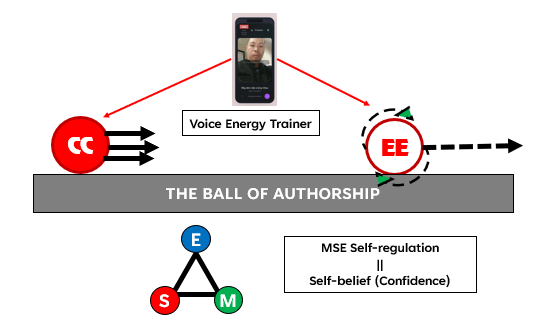
Both CC (Chunks Circle) and EE (Emotional English) are fundamentally self-authorship / MSE-regulation training systems—they just hit different phases of the same engine: start vs sustain.
Dimension | CC — Chunks Circle (v2.0) - 2026 | EE — Emotional English (v1.1) - 2025 |
|---|---|---|
Primary function | Ignition: help the learner start (break identity-guard, overcome inertia) | Stabilization: help the learner continue (maintain regulation through the whole speaking arc) |
Core heart | Rule of 1 Second + Book of CC (SPL / Self-Prom Logger) | BLOW / FLOW / CHUNKS practice loop |
Main training target | Entry into performance: “Can I begin as a new version?” | Sustained performance: “Can I stay that version until the end?” |
What it solves | The hardest step: getting the ball moving (snap-start under low resistance) | The long challenge: keeping the ball rolling (RPD-free stability under friction) |
Dominant friction | Identity-defense boot-up, overthinking, fear of shifting MSE | Identity-based friction during speech: drift, collapse, slowing, self-correction spirals |
Key mechanism | Time compression + daily self-credit: reduce resistance (1s) + build initiative (SPL) | Structure under motion: snap-start (blow) → continuity (flow) → stress-point control (chunks) |
Role of linguistics | Secondary; grammar corrected by Chunker (MSE over text) | Central-ish; language improvement is explicit, supported by MSE |
What “confidence” means here | The power to initiate (authored starting impulse) | The power to maintain (authored continuity + control under load) |
Observable win signal | Starts within 1 second; can mimic required MSE; logs self-promise wins | RPD-free delivery; stable flow; controlled n-stress / n-chunks across the sentence |
Metaphor | Start engine / break static friction | Cruise control / manage kinetic friction |
Best use-case | Learners who “know English but won’t speak” (identity wall) | Learners who start speaking but lose coherence midstream (collapse, drift, overthinking) |
Combined Protocol (why CC + EE works as a “confidence machine”)
- CC builds ignition power: lowers the guard + trains initiative (so the learner can begin).
- EE builds stability power: trains continuity + controlled stress (so the learner can finish strong).
CHUNKS claim (pragmatic):
When start-authorship (CC) and sustain-authorship (EE) are trained together, “confidence” stops being motivational advice and becomes a trainable, observable skill—the ability to command MSE at will from the first second to the last.
Therefore, if CHUNKS can truly shift someone’s confidence rate in this operational way (not self-help talk), that’s not just improving English—CHUNKS is upgrading their self-authorship, which is one of the few changes that can genuinely shift life trajectory.
The Rule of 1 Second is the thin threshold between unconscious feeling and conscious logic—the only moment when the ontological wall of “who I am” hasn’t fully risen yet and the learner’s defense is at its lowest. It’s the gap between:
- “Understand how to speak right” (logic, text, rules)
- “Feel how to speak right” (intuition, sound, embodied sense)
The original CHUNKS paradox
Communication is paradoxical because we must transmit non-linguistic meaning (intent, emotion, nuance, inner state) using linguistic tools (words, grammar). Miscommunication happens because the real message often lives not in literal text, but in chunks of sound—the wave-based nuance behind the words.
What the 1-second window changes?
Inside the 1-second window, the learner doesn’t have enough time to lock onto Vietnamese text as discrete word-units. They mostly receive only the auditory wave: rhythm, pitch, energy, facial/eye motion cues—non-linguistic signal.
That means the learner cannot do the usual word-by-word translation, because translation requires:
1/ capturing Vietnamese lexical units,
2/ mapping them to English units,
3/ assembling grammar consciously.
But in 1 second, that pipeline can’t fully activate. The learner is left with only one workable strategy:
Respond to the wave, not the words.
Convert felt meaning + heard nuance directly into English output.
That is exactly how fluent speakers operate: they don’t translate; they express from an internal wave-state into language.
Why this “shatters the paradox”?
The paradox said: We can only receive meaning through words.
The 1-second rule creates a condition where learners receive meaning before words dominate—so they can, for the first time, reliably catch the non-linguistic payload (MSE nuance) and output English from that.
So the paradox breaks like this:
- Old mode (≥2 seconds): text becomes dominant → logic starts → word-by-word translation → “how to speak right” (grammar gains, authenticity loss)
- 1-second mode: wave becomes dominant → intuition leads → direct expression → “feel how to speak right” (authentic speech pathway)
CHUNKS conclusion
Translation practice can improve grammar and conscious correctness, but it is not the tool for authentic speaking.
The Rule of 1 Second forces the learner into the native-like pathway: wave first → words follow, which is why it can trigger real speaking change rather than just more knowledge about speaking.