

CHUNKS DANCE
EMOTIONIFICATION: Create three points of resonance where movement, sound, and emotion come together.
OFFICIAL MASTER STRUCTURE (MN107.v2.1) – 7 PAGES
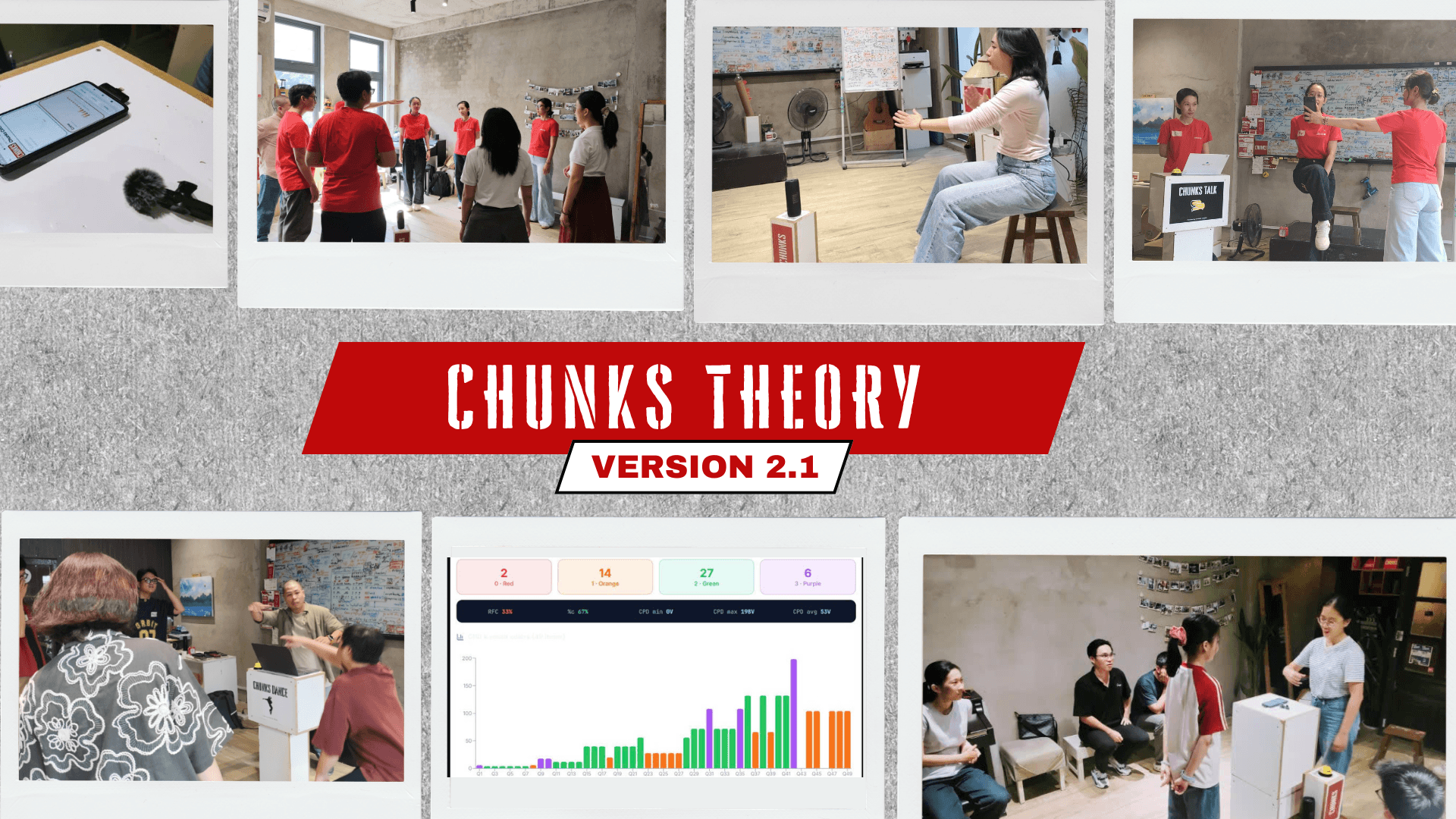
- Cover, Seal & Disclaimer
- Preface – Colors changing hue
- CHUNKS theory site: https://chunkstheory.com/
- Chunks official site: https://the-chunks.com/
- Chunks game site: https://game.the-chunks.com/
The Seven CHUNKS Paradoxes summarize seven core problems that led to the development of Special CHUNKS Theory (SCT), CHUNKS Education, and General CHUNKS Theory (GCT). The first three paradoxes target speaking, listening, and EBT through the Green, Red, and Blue CHUNKS Tests; the fourth forms the educational bridge from machine-like learning toward conscious human learning; and the final three extend the framework into three Chunks values: Freedom, Passion, and Compassion. Together, they introduce the three %cri metrics (%c, %r, and %i) for strengthening focus, improvisation, visual-audial observation, and ultimately the learner’s Conscious Level %C within the ASK process.
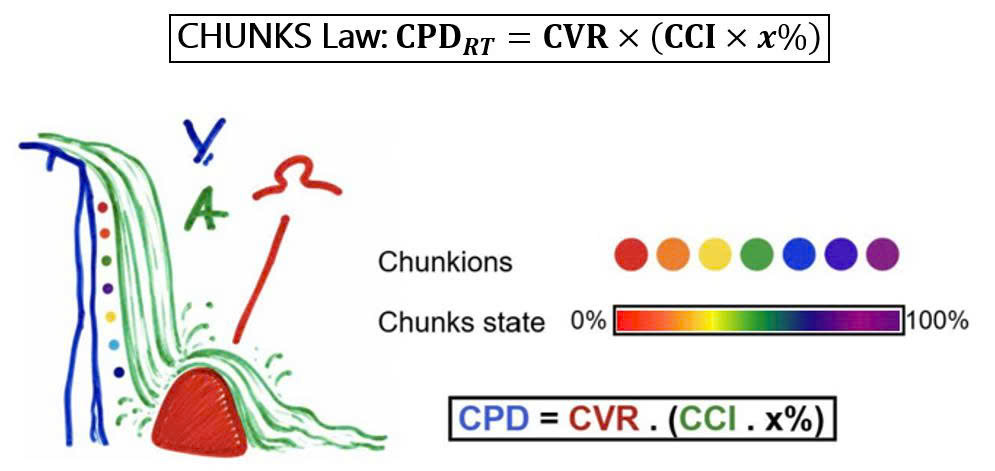
This page introduces the CHUNKS Law for measuring real-time Conscious Potential Difference (CPD). It defines how linguistic resistance (CVR), requested anti-habit action (CCI), and the human conscious-realization factor (%x) interact—revealing the fundamental difference between machine execution and conscious human learning.
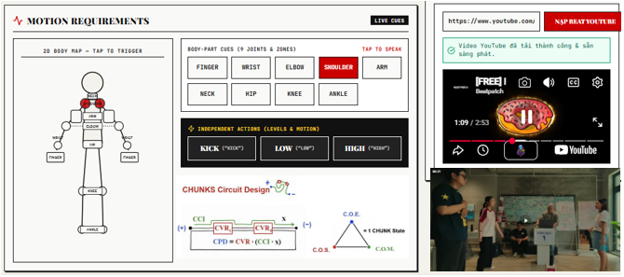
This page explores how CHUNKS DANCE “emotionifies” language through a three-stage Beat–Lyrics–Dance process, synchronizing Motion, Sound, and Emotion to generate self-authored MSE events. By combining freestyle expression with conscious boundaries, directional control, and clear stops, it unites Body, Sound, and Mind Gyms in one dynamic form.
CHUNKS Test Trilogy measures conscious performance under increasing pressure through three assessments: the 🟢 Green Focus Test (%c), 🔴 Red Improv Test (%r), and 🔵 Blue Observation Test (%i). Together, they reveal how attention, intention, and intuition align to form the learner’s overall Conscious Level (%C).
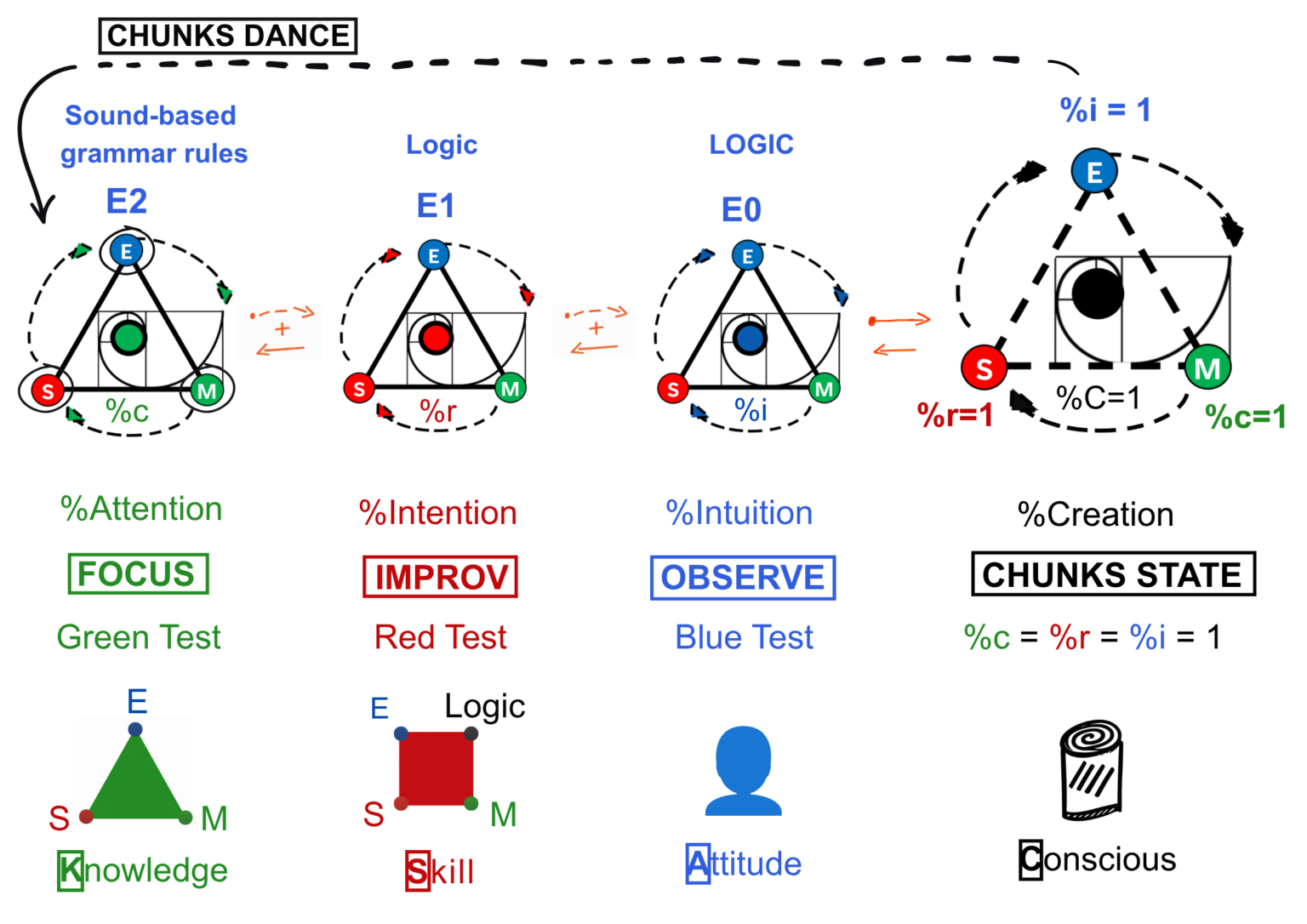
Green Test: A Focus assessment measuring how consciously learners maintain MSE resonance, follow anti-habitual requests, and transform mistakes under linguistic pressure. While the Green Test measures %c, CHUNKS Drills are designed to train and progressively upgrade this Focus skill.
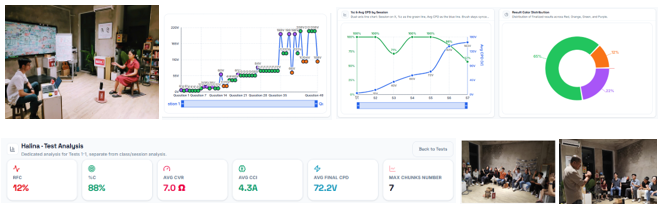
Red Test: An improvisation test measuring how consciously learners can redirect an unfolding idea under sudden, random hints while preserving sequential logic. Its unpredictable structure prevents rote learning and requires genuine conscious emotion-speaking in real time.
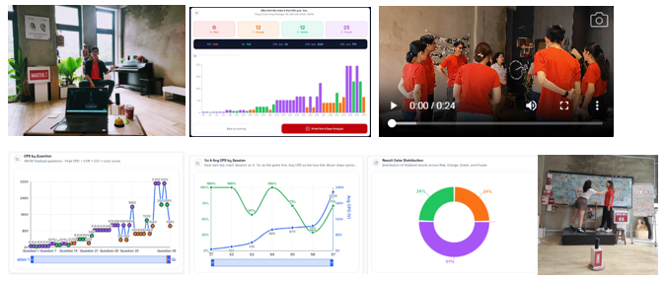
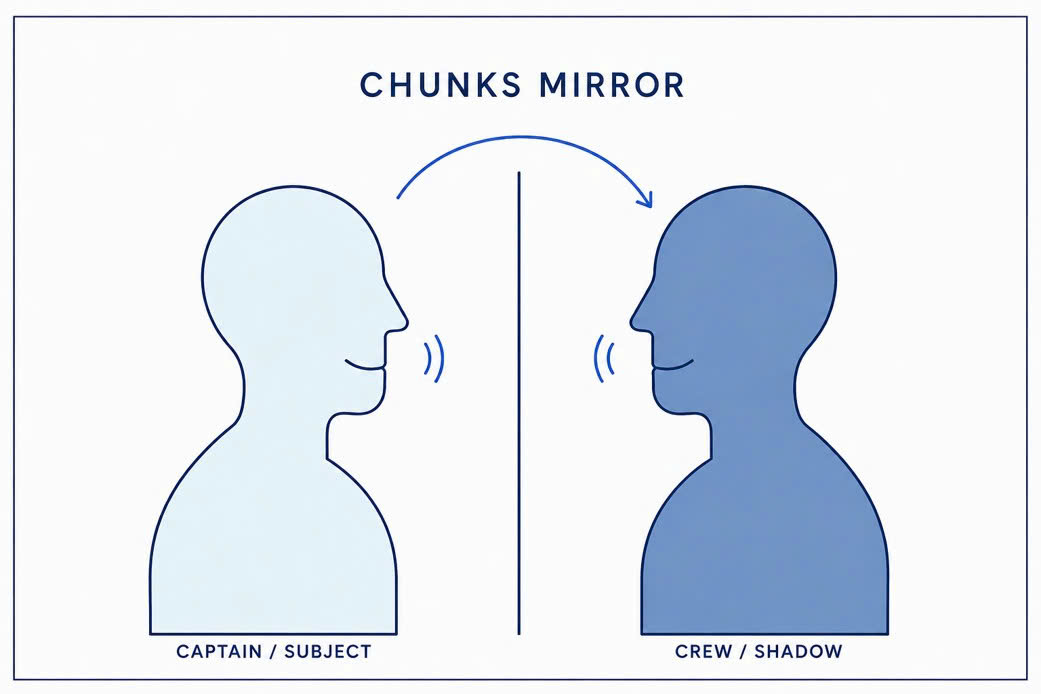
Blue Test: This special test measures the Captain’s intuition and judgment-free observation through 49 randomized Captain–Crew MSE challenges. While the Crew mirrors as an expectation-driven shadow, the Captain must remain calm, consciously observe it, and create a followable MSE shift that breaks its predictive flow. The test explores intuitive leadership, faith, freedom, and compassion toward one’s own shadow.

The beauty of CHUNKS Mirror lies in its central paradox: the Captain may remain fully conscious and still lose, but losing consciousness guarantees defeat. By facing an expectation-driven shadow with calmness rather than force, the Captain learns that true freedom, intuition, and leadership emerge through faith, compassion, innocence, and acceptance of the outcome.
Hues keep changing — Humans keep becoming.
There is a beautiful line in Vincent (Starry, Starry Night): “colors changing hue.” I kept returning to that image while developing this second part of CHUNKS Theory.
When colors change hue, we do not throw away the painting or replace the canvas. The canvas remains. What changes is the relationship among its color layers: one becomes brighter, another becomes softer, and something previously hidden begins to appear. It is still the same painting, but now we can see it differently.
I think human beings are a little like that. Education often tries to repaint people by adding more knowledge, correcting their attitudes, and training better skills. But what if the human canvas is not the problem? What if the colors are already there, and what we really need is a way to see their present balance and consciously adjust it?
That is the idea behind the Green, Red, and Blue Test Trilogy. Green measures %c Focus—the ability to stay with a request. Red measures %r Improv—the ability to create a logical direction in real time. Blue measures %i Observation. These tests are not personality labels. Nobody is permanently Green, Red, or Blue. They simply reveal our current hues under pressure, and those hues can move. The strange thing is that I did not design the whole trilogy at once. Each test grew from a different experience, and the original inspirations appeared in reverse order: Blue in 2022, Red in 2024, and Green in early 2026. It took me roughly six years to understand that these three moments belonged to the same picture.
Blue: “Your opponent is right”
The first seed appeared in a debate class in 2022. I began to think that the real challenge behind any heated argument could be expressed in my favorite line: “Your opponent is right. Try figure out why.”
This echoes the Socratic idea that no one knowingly chooses what they truly understand to be wrong. Behind both sides of an argument, there is usually something each person believes is good and worth protecting. The problem is that anything against our logic can feel like an attack on our existence. We rush to destroy the opposing argument because we cannot yet see through both positions. Watching my students, I did not see people brutally trying to destroy one another. I saw people miserably trying to protect themselves.
That became the Blue Test: Can we observe what is actually there before judgment takes over? Can we delay our logical filter long enough to see and hear another person clearly? Perhaps compassion and empathy are not meant to be forced. Once we see the good drive behind both sides, it may emerge naturally.
Red: Listening is more of a prediction game
The second seed appeared in a listening class in 2024. I was no better at hearing than my students. I heard exactly what they heard: incomplete chunks of sounds and scattered contextual hints. The difference was situational prediction.
I told them that listening is basically a context-based guessing game. We collect the available clues, make our best guess, and adjust when new information arrives. There is no shortcut, and being wrong is an inevitable part of learning the game. Then I noticed that the strongest improvisers were often the strongest listeners. They were not necessarily hearing more; they were better at forming a possible meaning, testing it, and changing direction. Funny enough, this listening ability had little to do with English itself. It came from contextual reading and basic logic.
That became the seed of Red Test: Can learners trust their own logic before being asked to follow everybody else’s rules? Can they guess, create a direction, and revise it as new hints arrive? A first guess does not need to be absolutely right. It only needs to make enough sense to begin.
Green: Why seven times?
The final piece arrived in early 2026. During a speaking session, I happened to ask a friend of mine to read an English paragraph aloud, only to realize that she was making one of her worst habitual pronunciation mistakes. After that, she tried repeatedly to correct that one mistake. And guess what?
It took seven attempts.
What concerned me was that she properly understood the correction and had heard it clearly only a moment earlier. It was not something from yesterday or last week that could be blamed on memory, as we often do. The correct sound was still present, but the old habit kept returning. Then she asked me seriously, “Elan, if you were me, how many times would you need to fix the same kind of mistake?”
“One, I guess,” I replied. “Why?”
Her question hit me hard. The issue was not simply whether we knew the correction. It was how much attention we could keep on that exact mistake while performing again.
That was how the Green Test was born. It asks: Can you stay with the request? Once a mistake has been corrected, can you keep that correction consciously alive and stop the habit from returning? This is also where %RFC (Requests Forgotten Coefficient) in the test suddenly becomes important in education and training. A high %RFC does not necessarily mean low intelligence or poor memory. It simply means that the request disappeared from consciousness under pressure.
This is where CHUNKS Dance comes in, before taking the official tests, learners should go through CHUNKS Dance because it would be unfair to evaluate Motion, Sound, and Emotion (MSE) before those three factors have learned to work together. Most learners begin as divided systems. Their minds know the words, but their bodies freeze. Their mouths speak, but their eyes disconnect. Their voices may be accurate but emotionally unavailable, or expressive but disconnected from the linguistic target. CHUNKS Dance helps “emotionify” MSE. A chunk moves beyond passive information: the learner can hear it, feel it, move with it, vary it, and express it. Beat first connects Motion and Emotion. Lyrics bring Sound into the circuit. CHUNKS Dance sessions then allows all three to move together more freely.
These three stories above brought me back to a question I had carried since I was young. Something always seemed missing from our familiar educational model of Attitude, Skill, and Knowledge, or ASK. Simply put, ASK is not wrong whatsoever. All three parts matter. But the model quietly assumes that the learner is consciously present. A student may possess knowledge but fail to access it when the situation changes. A skill may work automatically in practice but collapse under unfamiliar pressure. Even a good attitude may be performed because the teacher is watching. So where is the conscious observer? Who is actually seeing, choosing, and acting? To me, consciousness is the prerequisite that makes ASK usable. It makes attitude more than social performance and rather self-authored action. It makes skill more than mechanical repetition. It makes knowledge more than stored information.
The thing is, traditional education often assumes that when we make a mistake, we simply do not know, understand, or remember enough. That is why it teaches us to memorize better and, sometimes frustratingly, keeps repeating things we already know and understand so well. But perhaps the real problem is not what we know. Rather, it is whether we can keep that knowledge consciously available while acting under pressure. And this is most likely the root cause: our “perception bucket” is usually already full of memories, habits, beliefs, emotions, and expectations, so habit often reaches new information before consciousness does. Staying attentive is not a God-given ability that everyone automatically has; it is a skill that takes tons of practice. That is why even an excellent education system can keep pouring valuable information into learners and still watch much of it go down the drain.
Actually, I began this linguistic journey with the very same assumption. Back in December 2018, I wondered why people could spend years learning a language and still make grammatical mistakes so often. I assumed they simply had not known, understood, or memorized the fundamentals well enough. So, I launched my first 10-Day English class, believing I could cover everything a “rookie” needed to know and guide them out of the complicated jungle of language. Once they understood and memorized the basics, I thought, they would finally be able to speak correctly. But reality proved me dead wrong. Even when learners already knew and understood what to do, something deeper still stopped them from doing it right. At the time, I had no idea what it was. Perhaps education has long recognized this thorny problem, and yet repetition seems to be the best solution it has found so far.
— Elan (CHUNKS founder)
Dalat, August 2026