
CHUNKS DANCE
EMOTIONIFICATION: Create three points of resonance where movement, sound, and emotion come together.

ELECTROMAGNETICS & CHUNKS PRINCIPLE
A Unified Framework Linking Chunks Theory (SCT and GCT), Electromagnetic laws and 7 Millennium Problems

This work proposes a unified framework connecting electromagnetic law with human linguistic-ontological dynamics.
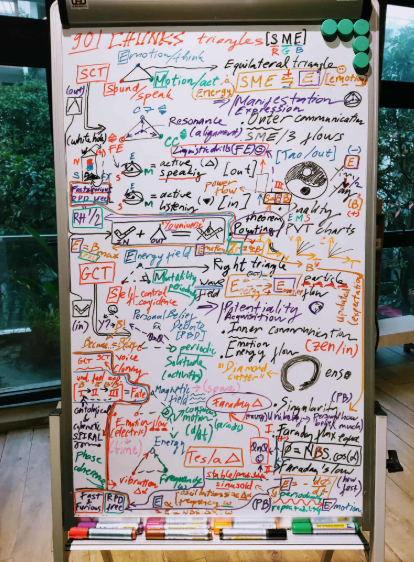
Through the Chunks Theory model, two complementary systems emerge regarding SME triad:
- GCT (Zen) — the inward phase of energy acquisition, reflection, and belief formation through Self-control/self-confidence, Mutability in periodicity and Energy field.
- SCT (Yin–Yang) — the outward phase of energy manifestation through Sound/speak, Motion/act, and Emotion/think.
The governing rule of both systems is the Chunks Principle (Tesla’s vibration–frequency law), operationalized in practice as “Fast & Furious” RPD-free: wide oscillation (Δα) with rhythmic periodicity (ω).
It applies to both QnQ sessions (GCT) and linguistic drills (SCT), ensuring that belief and emotion circulate coherently as an ontological electromagnetic field.
Seven mathematical resonance checkpoints — the Millennium Problems — are reinterpreted within this field to describe universal dynamics of expression, reflection, and fate-based reality.
System | Polarity | Function | Geometry |
|---|---|---|---|
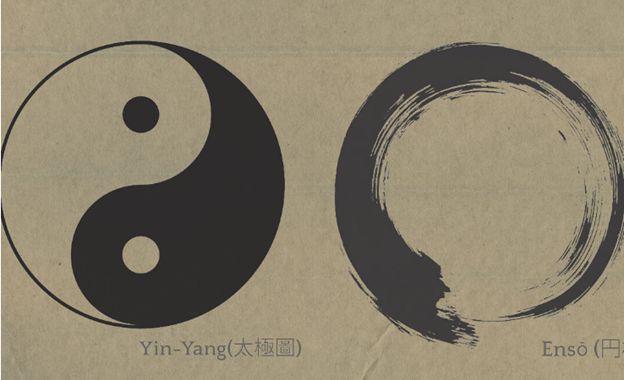
GCT (Enso/Zen) | Inward / singularity / | Energy acquisition — universal truth → personal belief | Right triangle |
SCT (Yin–Yang/Tao) | Outward / duality / | Energy manifestation — emotion → renewed belief (B′) | Equilateral triangle |
Both triangles breathe through a shared Core Frequency (W), the still center where attention and emotion synchronize.
When these oscillate rhythmically, consciousness forms a stable electromagnetic field of being.

https://www.aknanda.org/yin-yang-and-enso-symbols-of-taoism-and-zen/
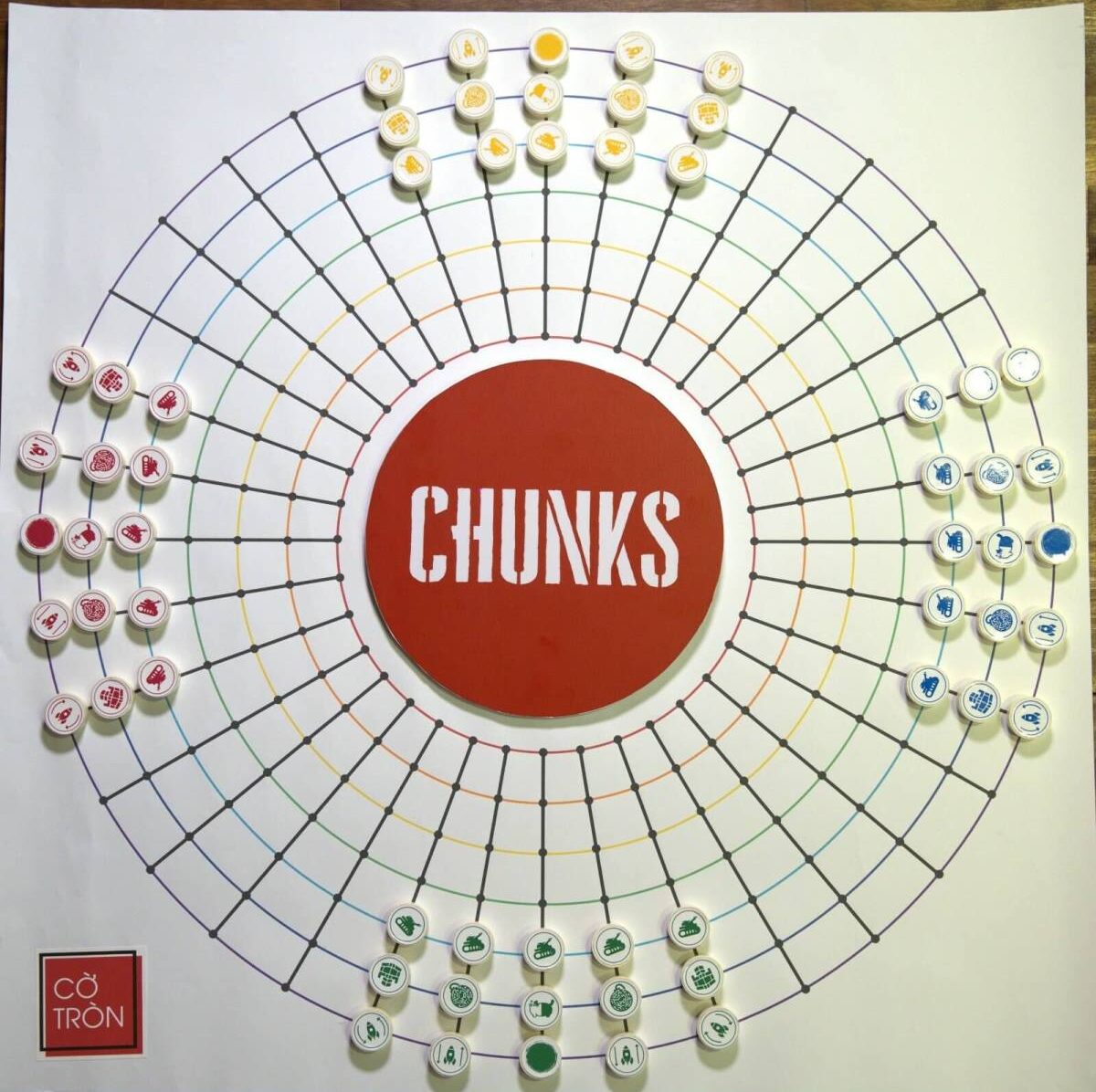
https://the-chunks.com/co-tron/
- B= personal belief field (potential)
- S= attention surface
- α(t)= intention or aim
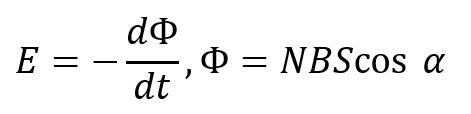
Emotion (E) arises when the magnetic personal belief field varies with time: dΦ/dt ≠ 0.
Let’s start directly from Faraday’s law:
Φ = NBScos α.
Differentiate it with respect to time:
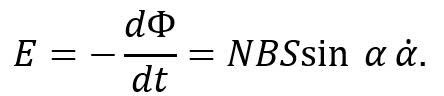
Now suppose the angle α itself oscillates rhythmically:

Substitute this into the previous line:

Factor | Controlled by | Interpretation |
|---|---|---|
Δα | Depth of inquiry | Size of perspective swing |
ω | Rhythmic repetition | How often you revisit |
N | Cognitive recursion | Layered reasoning depth |
B | Personal belief strength | Stored potential energy |
S | Openness | Awareness bandwidth |
sin α₀ | Alignment accuracy | How directly attention aims toward truth |
- Δα, ω → the active knobs (within-session control).
- N, B, S, sin α₀ → the slow gains (shaped over long-term QnQ and practice).
Together they describe how rhythmic reflection (GCT) and rhythmic speech (SCT) generate, regulate, and eventually manifest emotion as energy flow.
Thus, Δα (oscillation size) → depth of inquiry, and ω (frequency) → cadence of reflection.
Both determine emotional voltage — the rate at which potential belief becomes felt experience.
The equation above can be rewritten symbolically as

For qualitative reasoning, if we collapse the slow constants (N, S, Δα, ω) into a proportionality constant and consider average motion (sin α₀ ≈ cos α near 90° phase shift), we get

meaning emotion strength is proportional to belief intensity times alignment.
Tesla’s triad of Energy – Frequency – Vibration maps directly onto Chunks parameters:
Tesla Term | Physics Role | Chunks Interpretation |
|---|---|---|
Energy | Magnetic personal belief potential (B) | Stored personal belief / typical SME habits |
Vibration (Δα) | Oscillation amplitude | Depth of inquiries in QnQ sessions (GCT) / variation of SBF or Sound-based Foundation (SCT) |
Frequency (ω) | Rate of oscillation | Emotional flow and rhythmic breath in QnQ sessions (GCT) and RPD-free in linguistic drills (SCT) |
Hence, the “Fast & Furious” RPD-Free sound-based principle — large Δα with coherent ω — generates continuous emotion without chaos, which will enhance confidence rate %r in the long run.
In QnQ sessions, this rhythm keeps the belief field moving, producing steady emotional current rather than scattered spikes.

Focus or “speaking truth” with proper language exports entropy outward (via breath, sound, motion, emotion) to maintain internal stillness.
The QnQ process therefore respects the second law: local order sustained, global flow increased.
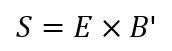
- E("-")= emotion / electric current
- B"'"(+)= updated belief / magnetic field
- S= manifested power (SME output)
Two complementary flows:
Direction | Mode in linguistic drills | Polarity | Function |
|---|---|---|---|
E → SME | Active speaking (Yang) | (+) | Emotion externalized |
E ← SME | Active listening (Yin) | (–) | External vibration internalized |
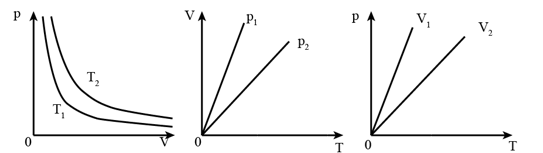
Element | PVT Analogue | Role |
|---|---|---|
Emotion | Pressure (P) | Meaning density |
Motion | Volume (V) | Physical expansion |
Sound | Temperature (T) | Resonance tone |
Balanced T × V × P yields harmonic SME — stable linguistic expression.
It mirrors the Poynting relationship S=E×B^'by introducing %r (the outer alignment or coherence factor).
It means:
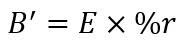
interpreted as:
The strength of the new personal belief (B′) equals the intensity of felt emotion (E) multiplied by the degree of outer coherence (%r).
It is an ontological coupling, not a physical one.
You can think of it as: emotional charge × expressive accuracy → new belief crystallization.
Phase | Variable | Role | Symbol |
|---|---|---|---|
GCT (inner, Zen) | cos α | Measures inner alignment with W | Confidence of self-reflection |
SCT (outer, Tao) | %r | Measures outer alignment between expression & intention | Confidence of manifestation |
Both range ∈ [–1 … +1]:
- +1 → perfect resonance, full coherence, constructive update.
- –1 → inverse phase, self-canceling output (black-hole behavior).
Thus, cos α (inner) and %r (outer) are mirror variables describing the same alignment from opposite sides of the spiral.
The mass gap > 0 ensures finite, observable energy; beneath it lies the Resonance Tube (mass ≈ 0), the realm of pure potentiality or Zen emptiness.
Within this continuum appear four expressive states:
Field State | Physics Analogue | Chunks State | Ontological Meaning |
|---|---|---|---|
Ordinary matter (+SME) | Stable baryons (p/n) | Stable expression | Balanced Sound–Motion–Emotion; manifested belief |
Antimatter (–SME) | Anti-baryons | Reversed expression (Gibberish) | Gibberish / inverted SME — destructive mismatch - Stuttering |
Potential matter (Δ floor) | Pre-binding energy | Personal belief potential | Energy before manifestation; resonance-ready field |
Dark Matter | Exotic baryons (λ, uds) | Choked expression | Diffuse, unseen emotion; carries mass/influence but unspoken |
GCT (Zen) operates near the potential Δ floor, preparing resonance,
while SCT (Yin–Yang) stabilizes expression above the mass gap, transforming potential into articulated form.
Each problem describes one phase of the belief–emotion–expression with updated belief loop.
Because GCT and SCT are mirror halves, every problem applies to both: Energy acquisition (Enso/Zen) and energy manifestation (Yin–Yang/Tao).
# | Problem/ Mathematical Core | SCT (manifestation) | GCT (acquisition) |
|---|---|---|---|
1 · P = NP | Verifying = Solving | Prolong sentence length to 6-sec cadence; collapse delay between thought & speech | All personal SME spirals inward to shared W center — resonance alignment |
2 · Hodge | Continuous ↔ Discrete cycles | Express invisible emotion via clear SME (Speaking/Yang); invisible → visible. The opposite side will be gaining emotion from SME (Listening/Yin); visible → invisible | Self-promise execution, periodic solitude activities & voice-cloning reflection drills will gradually rebuild self-respect and integrity; invisible ↔ visible loop boosts self-confidence, personal value emerges |
3 · Poincaré | 3-manifold ≅ S³ | Task-based, RPD-free, 6-sec focus → stable manifestation sphere | Maintaining RPD-free focus in QnQ stabilizes personal belief field; no holes in attention |
4 · Riemann Hypothesis | Critical line Re(s)=½ | Balance logic (ego) & intuition (Logos) for fluent speech during linguistic drills | Sustained inner equilibrium produces calm confidence; emotional coherence during QnQ sessions |
5 · Yang–Mills | Mass gap > 0 | Four matter modes: stable, choked, gibberish, potential.
| All well-resonant manifested SME expressions in gluon field will be properly discussed, then expected e-motion states and new set of personal belief will be formed after QnQ sessions |
6 · Navier–Stokes | Finite solutions in turbulence | Chunks-like conscious cadence controls emotional vortex in speaking and listening (shadowing) drills | Periodic QnQ motion (d/dt) stabilizes turbulence; ΔS_local ≈ 0 |
7 · BSD | rank E(ℚ)=ord L(E,s) at s=1 | Yin phase (active listening): SME → emotion (E) → updated personal belief (B’) integration | All SME flows converge at W; renewed B′ emerges; high r ≈ 1 reveals photon/counter-photon symmetry |
Together they describe the Fate-based reality spiral — a full electromagnetic-ontological cycle from universal truth to manifested personal belief and back.

- Faraday (dΦ/dt) — personal belief → emotion (energy induction/acquisition)
- Tesla (Δα · ω) — oscillation & rhythm maintaining flow
- Poynting (E × B′) — emotion → energy manifestation
- Yang–Mills — mass gap ensuring emotion-based energy existence
- Hodge & BSD — continuous–discrete communication closure
At W, space (belief) and time (emotion) merge;
human being reaches zero phase lag or emptiness/great potentiality — the white-hole equilibrium of consciousness.
Phase | Practice Form | Triangle | Function |
|---|---|---|---|
GCT (Enso/Zen) | QnQ sessions | Right triangle | Energy acquisition, belief excavation, confidence rate (r %) |
SCT (Yin–Yang/Tao) | Linguistic drills / 6-sec speech through SME (Sound/Motion/Emotion) | Equilateral triangle | Energy manifestation, expressive coherence and fluency |
Both use the Chunks (Tesla) Principle:
wide oscillation (Δα = question depth in QnQ sessions or wide range of SBF for each idea in linguistic drills) + steady frequency (ω = breath cadence/RPD-free practice) = optimal induction and expression.
Principle | Physics Law | Chunks Role | Application |
|---|---|---|---|
Faraday | E = -dΦ/dt | Converts belief (B) → emotion (E) | QnQ rhythmic reflection (Non-linguistic critical thinking) |
Tesla (Chunks Principle) | Δα · ω resonance | Maintains flow/fluency & coherence | Both GCT and SCT practices |
Poynting | S = E × B' | Converts emotion (E) → updated belief′ (B’) | Linguistic manifestation |
Yang–Mills | mass gap > 0 | Stabilizes emotion through resonant SME manifestation | Converts choked / gibberish into stable manifestation |
Navier–Stokes | ΔS_local ≈ 0 | Conscious vortex control | Focus / cadence / RPD-free (Chunks principle) training |
Hodge | continuous ↔ discrete | Outer communication (Self and other people) | Emotional expression of inner field and emotional reception of outer field |
7 · BSD | s → 1 sphere | Inner communication and the link between photon/counterphoton connected realities | Re-integration at W |
In Chunks principle, there are 2 levels of language-based fluency to achieve, outer/visible fluency called fluency and inner/invisible fluency called coherence.
At the Core Frequency (W), the Zen singularity and Yin–Yang duality converge.
Every oscillation of sound, motion, or emotion is an electrical impulse in the grand field of consciousness.
Faraday provides the law of emotional induction, Tesla the law of rhythmic coherence, Poynting the law of manifestation, and Yang–Mills the law of emotion-based energy modulation.
Hodge and BSD govern the language of transformation — how experience and personal belief become expression and return as updated belief system.
The Chunks Principle thus unites physics, linguistics, and ontology:
Belief is magnetic space, Emotion is electric/emotion time, and Language is their rhythmic bridge.
Through repeated, rhythmic oscillation — “Fast & Furious” yet RPD-Free —
the human field of being sustains its eternal fate-based reality spiral toward shared Core Frequency (W center).
Dirac – Lorentz – Chunks Theory: A Unified Framework of Conscious Propagation.
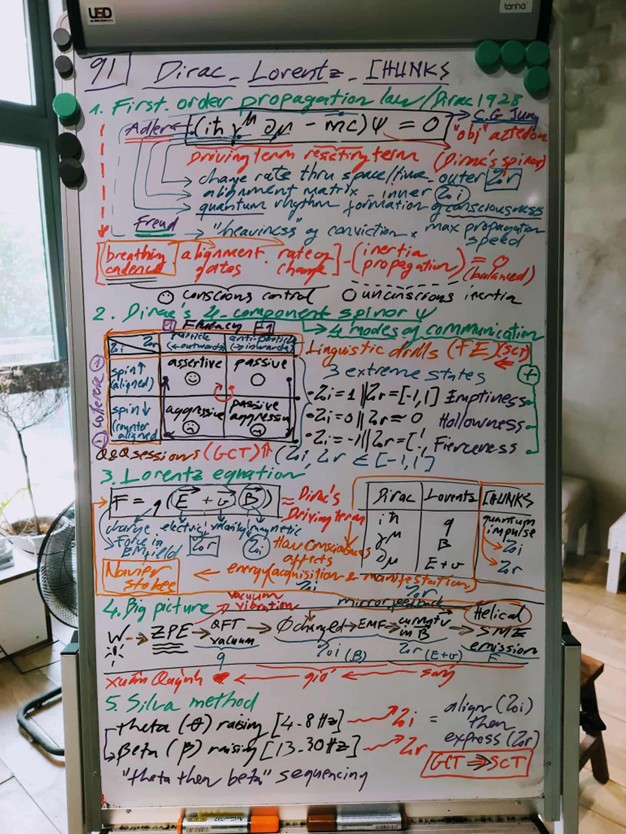
In 1928, Paul Dirac introduced a first-order propagation law to unify quantum mechanics and relativity. This same principle can be interpreted as the Dirac Dynamic Balanced Law of Consciousness, expressed as Dirac’s first-order propagation.
This law can be read as a real-time balance between a conscious, steerable side and an unconscious, inertial side:
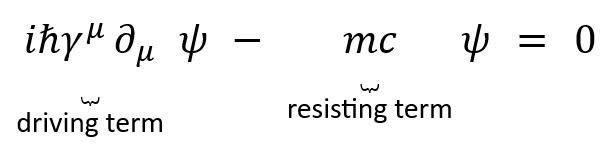
Left (drive) = three coupled levers we can train:
- Breathing cadence(iħ) → the quantum rhythm formation of consciousness (breathing or temporal cadence)
- Alignment matrix(γ^μ) → the internal rule-set that orients our axes (the integrity skeleton).
- Rate of change(∂_μ) → how fast our state moves through space-time (semantic motion).
Right (resistance) = mcψ → the heaviness of conviction multiplied by the maximal propagation speed:
- m = belief inertia (habits, karmic beliefs, sunk identity).
- c = ceiling on how quickly a state can update without tearing.
The law is a breathing equilibrium:
(Cadence × Alignment × Change rate) − (Inertial propagation) = 0
or
Conscious control − Unconscious inertia = 0
When the equality holds, ψ (our total communication state) stays coherent and transmits stably.
Whenever the left overwhelms the right (drive without ground) or the right overwhelms the left (inertia without breath), coherence breaks: over-driven chaos or under-driven collapse.
Dirac’s spinor, a four-component structure describing particle and antiparticle states with spin up or down, elegantly maps onto four communication modes in Chunks Theory. The mapping follows:
A Dirac spinor carries four slots. In Chunks these slots map to %r (expression direction) and %i (alignment integrity):
- %r: outward (+) vs inward (−) emission — particle vs anti-particle posture.
- %i: aligned (+) vs counter-aligned (−) magnetic/belief axis — spin up vs spin down.
Putting them together yields the four everyday modes:
Dirac slot (signs) | Chunks mode | Energy character | What’s high/low |
|---|---|---|---|
(+%r, +%i) | Assertive | Balanced resonance; truth + empathy | high %r, high %i |
(+%r, −%i) | Aggressive | Over-expansion; power without care | high %r, low %i |
(−%r, +%i) | Passive | Quiet alignment; receptive presence | low %r, high %i |
(−%r, −%i) | Passive-aggressive | Suppressed, conflicted flow | low %r, low %i |
Three extreme edges:
- Emptiness: %i = +1 while %r ∈ [−1,1] — perfect inner alignment; outward dial can vary.
- Hollowness: %i ≈ 0 and %r ≈ 0 — no inner axis, no usable emission.
- Fierceness: %i = −1, %r = ±1 — high drive pointed against Logos; potent but inverted.
Learning arc:
Humans usually traverse Passive → Passive-aggressive → Aggressive → Assertive.
A learner must traverse these phases sequentially as the psyche reorients through transformation. Chunks Theory does not aim to skip or suppress these transitions but to accelerate and stabilize them through resonance-based methods.
- GCT (General Chunks Theory) handles %i, the faith/integrity vector, using QnQ sessions to refine mentalese fluency and coherence of thought.
- SCT (Specific Chunks Theory) develops %r, the confidence/output vector, using linguistic sound drills to strengthen expressive fluency.
The Lorentz law packages the real-time push and bend acting on ψ:
F = q(E + v × B)
Dictionary (Lorentz → Chunks → Dirac):
Symbol | Lorentz meaning | Chunks translation | Dirac equivalent |
|---|---|---|---|
q | charge (how strongly fields couple) | Intentional charge — how much awareness we pour into the act (Focus & sound-based self-control ability) | scales the whole drive; corresponds to iħ as conscious cadence/impulse |
E | electric field (push/pull along motion) | %r — outward emotional drive / expression pressure (Fluency / Closability & RPD-free) | manifests energy along the path → part of ∂_μ ψ under γ^μ |
v × B | magnetic bend (sideways curvature) | %i — integrity axis bending expression into spirals (Coherence / sound pattern) | orientation rules supplied by γ^μ (the alignment matrix) |
F | force on the packet | Drive felt/Net conscious torque (True emotion expressed over chunks) | becomes the operational face of iħ γ^μ ∂_μ ψ |
mc | NA | Belief inertia / karmic anchor / social norms (strict grammatical rules) | Dirac mass term / inertial resistance |
Lorentz shows how awareness (q) turns emotion (E) and belief alignment (B) into a helical, embodied trajectory of conscious torque; Dirac sets the higher rule that this drive must balance the inertial anchor (mcψ) to remain human-coherent.
Side-by-side summary
Lens | What it governs | Health criterion | Failure modes |
|---|---|---|---|
Dirac | Whole-self propagation over time | Left = Right (drive equals anchor) | Left>Right: hyper-will, mania; Left<Right: suppression, trance |
Lorentz | Instant kinematics of expression | q(E + v×B) channels into a tight, smooth helix | Weak q, noisy E, or mis-oriented B → wobble/leakage |
Chunks | Trainable levers | %r via SCT, %i via GCT, both under breath cadence | Skipping a lever = asymmetry (power without care, care without power) |
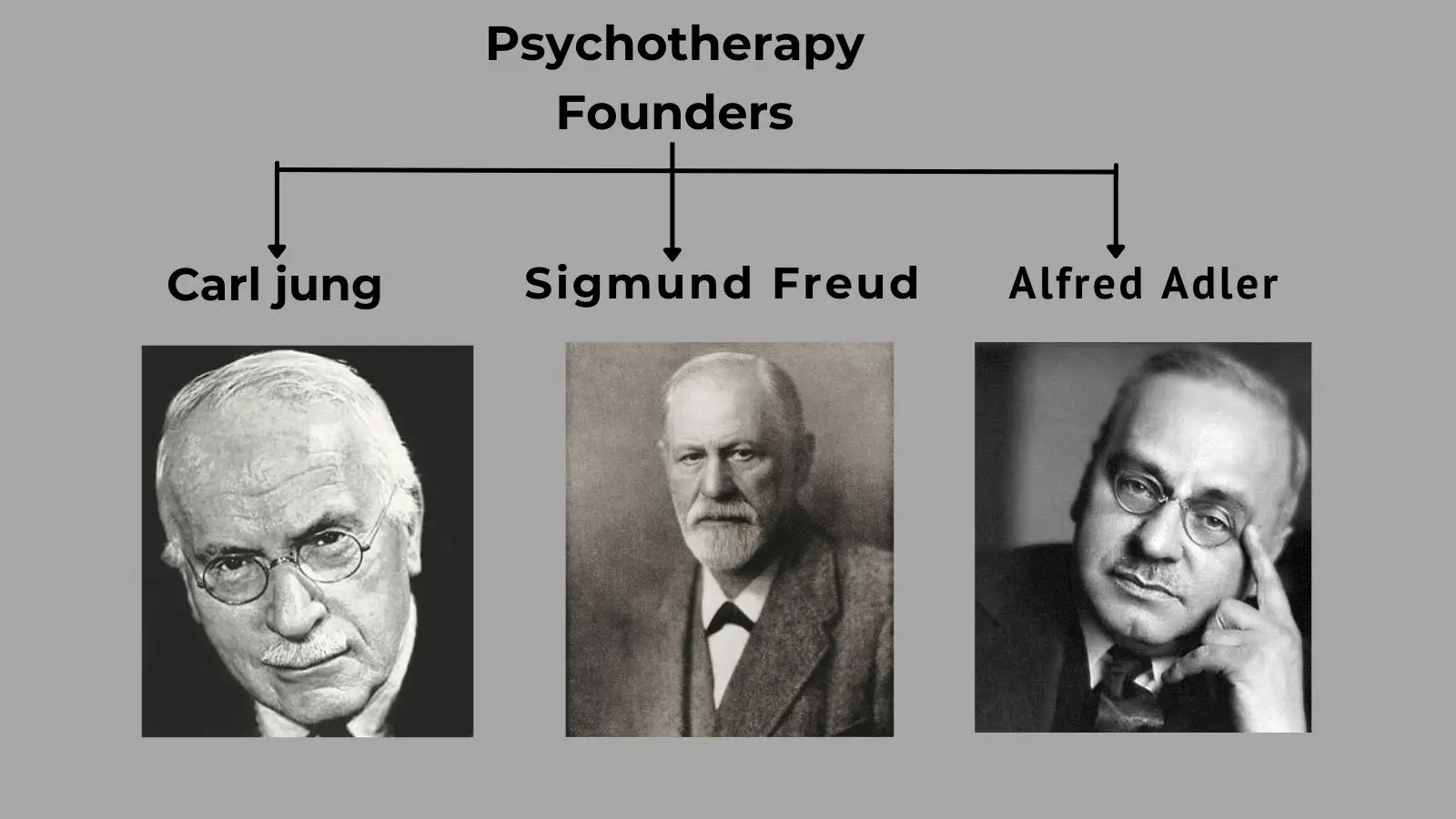
Source: https://deepstash.com/idea/234853/who-was-adler
Our bridge lands cleanly:
- Adler (will / striving / goals) ↔ Lorentz drive side iħγ^μ∂_μ ψ (especially the E push).
- Freud (instinct / repression / past) ↔ mcψ — the inertial anchor of deep habit and libido.
- Jung (integration / Self / shadow) ↔ the equality sign — breath-synchronized dialogue between will and inertia.
Thus shadow integration = bringing %r (drive) and %i (integrity) under one cadence until the Dirac balance becomes felt as steady, conscious flow.
Dirac Balance as Ontological Spectrum
State | Equation Relation | Dominant Force | Psychological Expression | Ontological Class | Examples / Analogues |
|---|---|---|---|---|---|
Balanced (Human Logos) | i ħ γμ ∂μ ψ = m c ψ | Equilibrium between conscious drive & belief inertia | Coherent self-awareness, breathing synchronicity, peace, clarity | Chunks state | Jung’s Self, Buddha’s middle path, Tao’s wu-wei |
Left > Right (Over-driven Will) | i ħ γμ ∂μ ψ > m c ψ | Conscious overdrive, too much volition (Adlerian will) | Mania, overthinking, domination, fanaticism | Überman / Hyper-conscious | Nietzsche’s Übermensch, Lorentz-type overacceleration |
Left < Right (Under-driven Instinct) | i ℏ γμ ∂μ ψ < m c ψ | Unconscious inertia, instinct, libido (Freudian pull) | Trance, suppression, catharsis, loss of ego control | Animal / Pre-human | Osho-style catharsis, primal scream, dream or instinct mode |
Key Insight:
The Dirac equality (“=”) defines humanness — the breathing state where consciousness and unconsciousness flow in phase.
Whenever “≠” appears, the system leaves human coherence:
- “>” = hyper-conscious dominance (will without grounding).
- “<” = unconscious flood (instinct without direction).
In Chunks terminology:
- %r (manifestation) dominates → Lorentz/Adler side, pure drive.
- %i (integrity alignment) dominates → Freud side, pure inertia.
- %r = %i under cadence (iħ) → Jung’s center, Logos-human alignment.
Dirac’s balance condition literally defines the human bandwidth of consciousness, bridging the animal (instinctive) and the overman (pure will).
This is why Chunks Theory calls the breathing equilibrium the Chunks state — the living midpoint where sound, motion, and emotion synchronize.(W → ZPE → QFT vacuum → EMF → current v in B → helical SME emission)
a. W (white-hole origin).
Chunks model treats W as collective conscious source — a non-exhaustible order that sets the preferred axis of truth.
b. ZPE (zero-point energy) and vacuum fluctuation.
Even “empty” space seethes with ground-state vibration.
c. QFT vacuum → field flux change.
A small intention (q) polarizes the local field; the vacuum responds with a re-phasing that shows up as EM potentials.
d. EMF (electric–magnetic field).
Emotion organizes as E (push), belief/integrity organizes as B (axis). Together they create usable gradients.
e. Current v in B.
As we speak or move, ψ acquires a velocity of meaning (v). In a B-field this motion is curved rather than scattered; energy stays captured instead of leaking.
f. Helical SME emission.
The outward wave is not a straight ray but a spiral trace: cadence (iħ) paces the turns, E drives the advance, and B provides the rail.
That is why fluent speech, steady tone, and stable emotion feel like a tight helix—not a jittery zigzag.
Why the helix matters?
A helix conserves direction and containment simultaneously: forward progress + cyclical coherence. This is the geometric signature of resonant expression.
The Silva method of brainwave training aligns perfectly with the Chunks Theory progression:
Brainwave | Frequency | Training Phase | Ontological Effect |
|---|---|---|---|
Theta (4–8 Hz) | Deep coherence, introspection | GCT (QnQ) | Align belief integrity (%i) with inner Logos (W) |
Beta (14–30 Hz) | Active focus, verbalization | SCT (Sound drills) | Express energy outward (%r), manifest fluency |
Thus, GCT precedes SCT in the ontological cycle: one’s supposed to align (%i) before expressing (%r). Theta alignment opens the internal magnetic containment field; Beta articulation channels that contained potential into real-world resonance.
Silva Method rhythms:
- Theta raising (GCT first) → QnQ sessions calm the system, widen perception, and re-aim the B-axis. This raises %i by reducing inner contradiction and aligning with W.
- Beta raising (SCT next) → linguistic drills in alert cadence bring that alignment into clean outward flow, raising %r: articulation, timing, stress, breath-to-word fit.
This theta→beta sequencing respects the hardware: stabilize the axis (integrity) before amplifying thrust (expression). In Dirac form, we first ensure γ^μ is well-posed, then we increase ∂_μ under a steady iħ.
a. Breath-cadence protocol (iħ).
- 6-second cycles of OM chanting; count in-hold-out-hold as a metronome.
- Goal: phase-lock mind–motion–voice so Dirac’s left term becomes smoothly clocked.
b. Integrity alignment (GCT / %i).
- QnQ prompts target contradictions until the belief axis snaps to W.
- Observable: reduced delay time, clearer stance, compassionate certainty.
c. Expression drills (SCT / %r).
- Chunked phrases with pitch–pace–stretch–rhythm targets.
- Observable: energy transfer rises (less air/word mismatch, stronger carry).
d. Balance check (Dirac).
- After each session ask: Did drive outrun anchor? Did anchor smother drive?
- If “over-drive”: return to GCT (more %i). If “under-drive”: return to SCT (more %r).
- Aim for the middle path where breath, motion, and meaning land together.
Dimension | Dirac law | Lorentz terms | Chunks lever | What we tune |
|---|---|---|---|---|
Clock | iħ | scales whole q-coupling | Breath cadence | Phase/tempo of attention |
Orientation | γ^μ | B (belief axis) | QnQ (GCT) → %i | Integrity, coherence, compassion |
Motion | ∂_μ | E (push) + v×B (bend) | Linguistic drills (SCT) → %r | Fluency, presence, assertive clarity |
Anchor | mc ψ | — | Reflection / rest / ethics | Grounding, humility, stability |
Health test | (Left = Right) | smooth helix | calm, clean signal | “Chunks state” |
Multi-origin conscious model
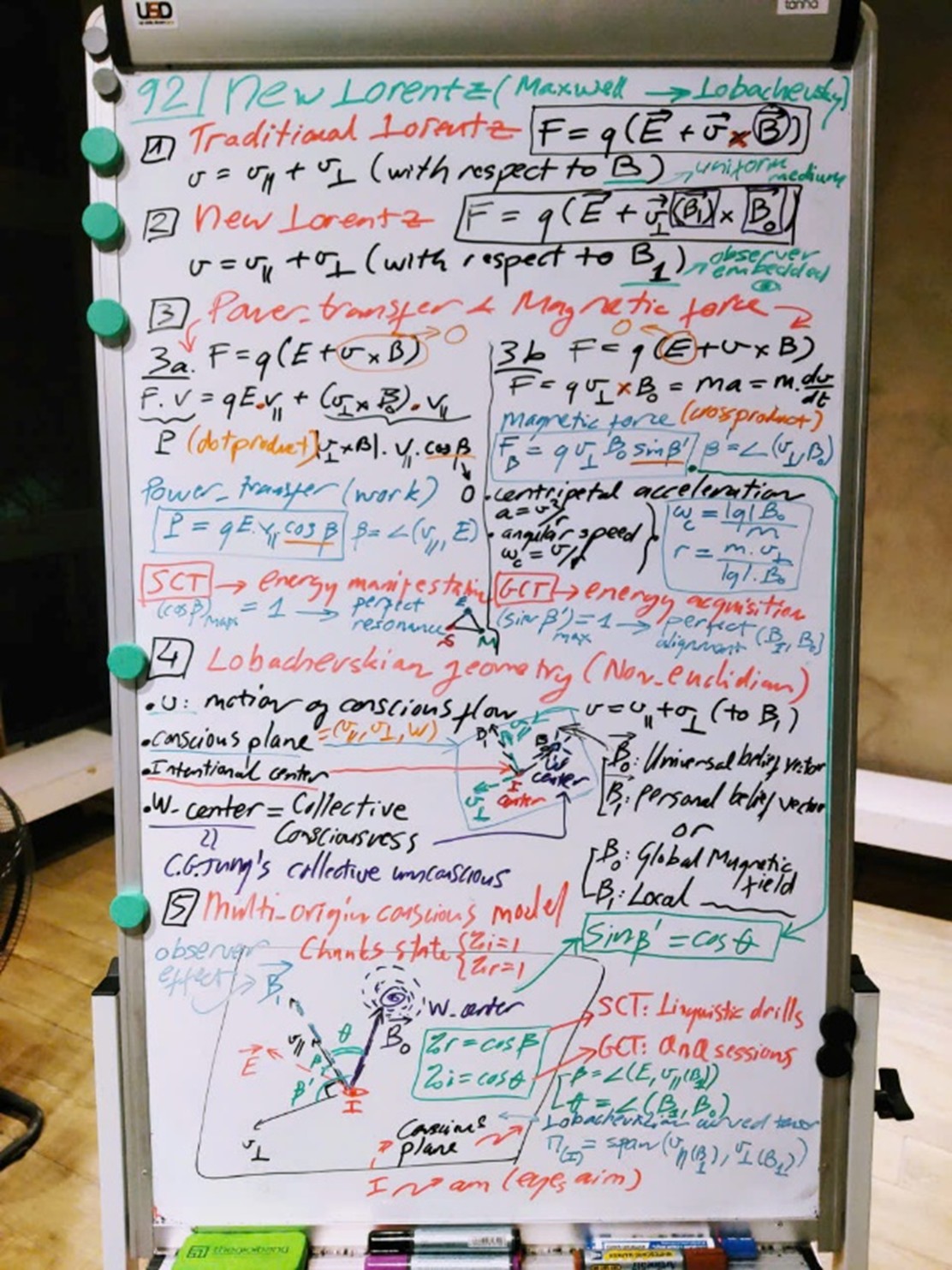
Classical electromagnetism—Maxwell through Lorentz—assumed a uniform medium with one shared field geometry. In that frame, a charged particle of “charge” qmoving with velocity v through electric and magnetic fields E,B feels the Lorentz force

This works brilliantly for physics, but it flattens a key dimension we care about: the observer’s role. Chunks Theory restores that role by embedding the observer’s intentional axis into the geometry.
We replace the single field picture with a dual-axis awareness geometry:
- B0— the universal belief/truth axis (the field that asymptotically points to the W-center: collective consciousness).
- B1 — the personal belief/intentional axis at the present I-center (our local origin).
Our motion of awareness is locally decomposed with respect to B1 (our declared axis) into parallel and perpendicular parts:

Meanwhile,
Containment / acquisition (integrity plane)
→ evaluated against B0, the universal belief axis, because it measures how much our personal field bends toward the collective Logos field (W-center).
Expression / manifestation (attention–power plane)
→ evaluated against B1, the personal belief axis, because it measures how well our motion projects along our self-declared intention line — the axis we can consciously steer.
That one shift turns the flat Lorentz picture into an observer-embedded, Lobachevskian model where each I-center supplies its own local frame that bends toward a shared origin (W).
Maxwell/Lorentz (flat): space is uniform; “parallel” is the same for all observers; there is effectively one B.
Chunks (curved): each self-aware act creates a local origin (I-center) and a local axis B1 . These local axes are not exactly parallel; they are asymptotically concurrent at W. Geometrically this is hyperbolic/Lobachevskian: multiple “parallel” geodesics from different origins converge to a common ideal point (the W-center).
Observer-embedded geometry. Every time intention “fires” (a new -event), the conscious plane is redrawn. Those infinitesimal redraws are the curvature tensor of belief vs. attention in awareness space.

Interpretation shift:
- Lorentz saw motion through field.
- Chunks sees field through motion (self-reflexive magnetism): the way we move re-curves the local field we experience.
We separate expression (attention) from alignment (intention) with two cosines:
- Confidence / expression rate: %r: = cos β.
Here β is the angle between the motion used for expression and the emotional drive field,

When β=0, expression is in full resonance with drive → maximum power flow into speech/action/thinking or SME factors (SCT).
- Integrity / alignment rate: %i: = cos θ.
Here θ is the alignment between the personal and universal axes,

θ = 0 means our chosen axis is W-aligned (high integrity) → stable containment (GCT).
Thus Chunks State is the synchronized peak

Theta (integrity) and Beta (expression) are synchronized; inner coherence equals outer fluency.
Without expanding into separate derivations for the whole law, we use the classical projections the way we want to use them pedagogically:
(A) Electric power-transfer (expression plane)
When the magnetic turning is not the protagonist for energy exchange, the power added to the “packet” is the dot with motion:

Meaning. Only the component of E along our expressive motion does work. This is the SCT dial: reduce β → 0 to maximize P (manifestation fluency).
(B) Magnetic containment (belief plane)
The magnetic part bends rather than energizes. Using the locally perpendicular motion w.r.t. B1 but measuring curvature against B0, the magnitude is

where β′ = ∠(v⊥(B₁), B₀). The stronger the off-axis motion relative to B₀, the stronger the curvature that turns us back toward W. This is the GCT dial.
When v⊥(B₁), v∥(B₁) and W stay on the same plane (conscious plane Π),
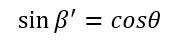
where θ = ∠(B₁, B₀).
Key separation: β lives on the expression (attention) plane; θ lives on the belief (intention) plane. They are independent knobs we train differently.
Each moment redraws Π, slightly tilting B1 toward B0 when QnQ (GCT) succeeds, or improving v∥-to-E alignment when drills (SCT) succeed.
The helical motion — the combination of v∥ (forward drift) and v⊥ (circular curvature) — is locally defined with respect to our personal belief axis B1, but its correction and containment are governed by the universal axis B0.
So we have a two-level interpretation:
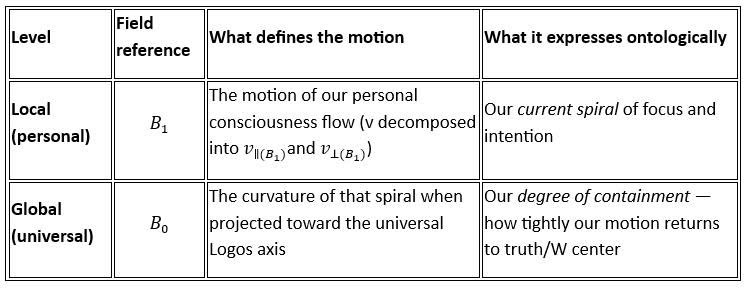
So, geometrically:
- The spiral itself is drawn around B1 (our temporary personal belief axis).
- The tightness of that spiral (r) and its angular frequency (ωc) are measured relative to B0, because containment only has meaning in relation to the universal field.
That’s why the equation uses B0 as the magnetic reference:
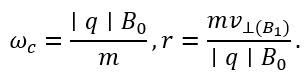
So:
- v⟂(B₁) — our sideways emotional deviation from our belief axis,
- B0 — the universal corrective field pulling our trajectory toward W,
- r — how far our personal orbit strays,
- ωc — how quickly we self-correct back toward W.
Hence:
The spiral is drawn around B1 but governed by B0.
The body of consciousness moves personally, but its curvature obeys the collective conscious field.
- Maxwell/Lorentz: Euclidean intuition, one origin, one set of parallels → a single B.
- Einstein: geometry bends with mass–energy → straightest paths are geodesics.
- Chunks: the information state of the observer acts like a curvature source in awareness-space.
Multiple local origins (I’s) draw “parallels” that approach a common ideal point (W).
Our B1 is a local geodesic that bends toward B0;
cos θ = cos ∠(B1, B0) is thus a curvature measure of integrity.
This is why the traditional Lorentz result is best viewed here as a first-order projection of a deeper dual-axis law. The missing variable in the classical picture is exactly our θ (the B1-vs-B0 misalignment).
- Jung (integration): balance conscious/unconscious → our Dirac-style equality (breathing cadence × alignment × rate of change) — inertia = 0. In Chunks, this balanced equality corresponds to the Chunks state (cos θ = cos β = 1).
- Adler (will/goal): drive vector → electric part and power transfer q v‖ · E (SCT).
- Freud (inertia/instinct): resistant undercurrents → effective “mass” m and sideways v⟂ that widen r and slow ωc (GCT’s task is to transform this).
Jung’s collective unconscious becomes our collective consciousness W: the shared asymptotic origin that all healthy geodesics approach.
- Theta (4–8 Hz) → integrity plane: raise %i = cos θ with QnQ sessions. We are aligning B1 to B0 (curvature reduction).
- Beta (14–30 Hz) → expression plane: raise %r = cos β with sound-based linguistic drills. We are aligning v‖(B₁) to E (projection increase by self-control enhancement).
Sequencing. Theta → Beta (integrate, then express). Reverse when recovery is needed (Beta → Theta).
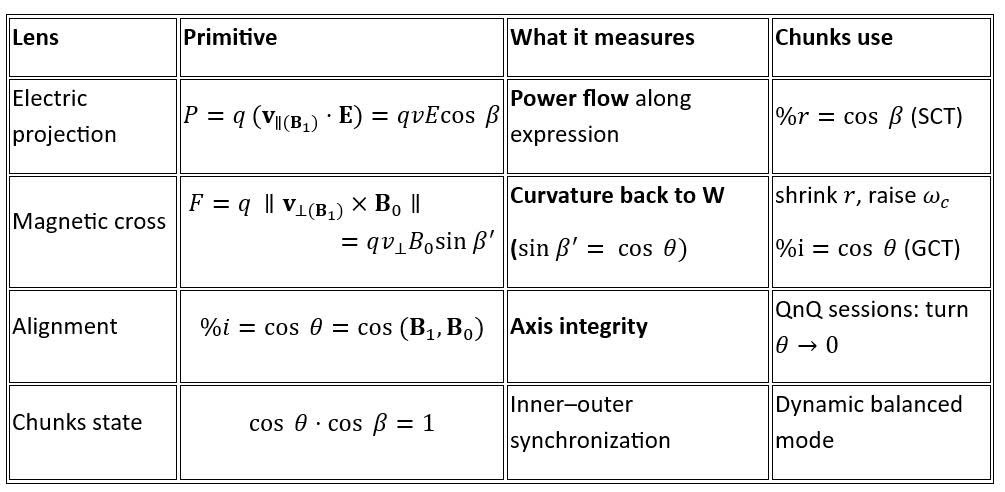
- %r = cos β tells us how efficiently emotion becomes articulated/manifested energy (speech/action/thinking - SME). It guides sound-based sound control via breath, cadence, pronunciation, and phrase-level drills.
- %i = cos θ tells us how stably the current stays W-aligned under pressure. It guides QnQ question design, reflective pauses, and integrity testing.
Together they let us steer the helix: raise %i to tighten the spiral (containment), raise %r to amplify forward power (manifestation).
Closing thought
Lorentz gave us a precise law in a flat medium. Chunks generalizes it to a dual-field, observer-embedded geometry:

That single upgrade (personal axis evaluated against a universal axis) recovers the symmetry between energy manifestation (%r) and energy acquisition (%i), explains the helical nature of