
CHUNKS DANCE
EMOTIONIFICATION: Create three points of resonance where movement, sound, and emotion come together.

Psychoanalysis [MIRROR NODE#49]
Start from our master metaphor:

We read this as the breathing equilibrium of a human psyche.
- Left side – drive term
○ iħ → cadence / consciousness (breath, temporal rhythm).
○ γμ → alignment matrix (inner rule-set, integrity skeleton).
○ ∂μ → rate of change (semantic motion through space-time).
Together: how fast and in what direction the self moves.
- Right side – resistance term
○ m→ belief inertia (habits, karmic weight, sunk identity).
○ c→ maximum propagation speed (how fast we can update without tearing).
This is the heaviness of conviction.
The equality sign means:
Conscious drive × alignment × change rate = unconscious inertia
When the equation “breathes” well, we feel like a coherent self; when it breaks, neurosis or collapse appears.
We then map the four masters onto this equation:
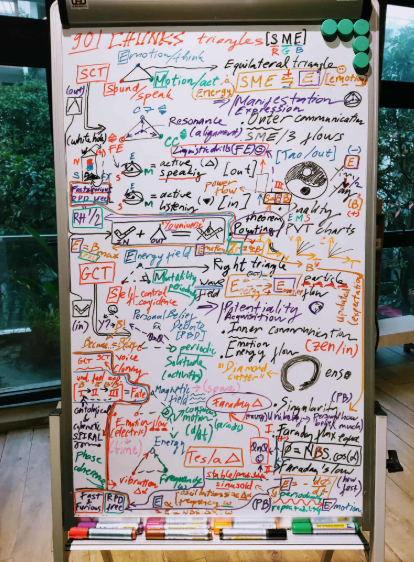
• Freud → the mass term mcψ: libidinal inertia and repressed drives.
• Adler → the drive side iħγμ ∂μψ: striving, will, direction in life.
• Jung → the equality itself: reconciling drive and inertia through individuation (shadow integration, Self).
• Lacan → the update rule in time: how the whole spinor ψ moves in a helical path of signifiers around a Real point; the syntax of desire.
Chunks Theory stands on top of this physics-psyche bridge: we treat sound, motion, emotion as the concrete way this Dirac balance is trained in real time.
Freud’s model is a flow diagram of psychosexual energy:
- Id – raw libido (Eros) plus death drive (Thanatos). Blind, timeless, seeking discharge.
- Ego – mediator trying to satisfy the id while respecting reality.
- Superego – internalized social and parental law; punishes and judges.
Mental suffering appears as conflict: id vs superego, pleasure vs prohibition. Symptoms (phobias, compulsions, slips) are compromise formations where energy leaks out in distorted form.
For Chunks language:
- Freud is the “mass” side : the heavy reservoir of B0’ – personal shadow drives and repressions – pressing upward into B1 and B2.
- Therapy = make the unconscious conscious enough so the ego can negotiate without collapse.
Adler flips attention from libido to striving and social belonging:
- Every child experiences inferiority (small body, limited power).
- We respond by creating a style of life: a unique pattern of goals, compensations, and fictions.
- Healthy development builds Gemeinschaftsgefühl – community feeling: the sense “I belong and can contribute.”
Neurosis = rigid style of life that protects self-esteem but cuts our off from others (superiority complex, avoidance, perfectionism).
In Chunks terms:
- Adler works mostly in B1 ↔ B2 space:
- B1: my self-image (“I am capable / I’m worthless”).
- B2: social field (family, school, culture).
He’s about direction of will on the Dirac left side: which vector do we choose to move toward?
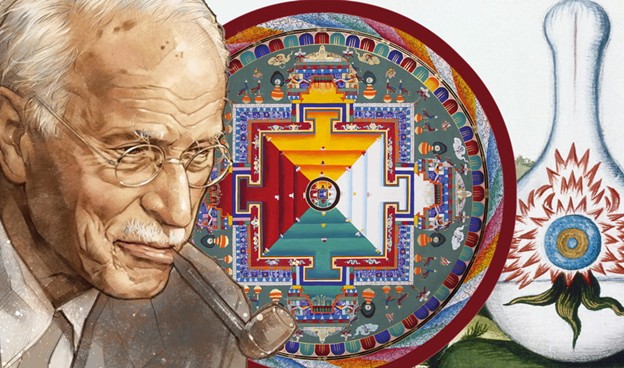
Source: https://news.acropolis.org/2023/c-g-jung-mandala-and-alchemy-of-the-soul-bulgaria/
Jung goes deeper into B0 / B0’:
- Shadow – all impulses, traits and desires the ego disowns. This is our personal B0’: the dark basement that actually carries huge energy.
- Collective unconscious – the B0 field of archetypes: universal patterns (Mother, Hero, Trickster, Self, etc.) that shape dreams, myths, and fantasies.
- Individuation – the life-long process of integrating shadow, persona, anima/animus, and finally orienting to the Self (the inner mandala-center).
The mandala for Jung is a 2-D map of psychic wholeness: a circle or square with a center. It is a symbolic snapshot of an inner S³-like sphere: when all parts orbit a central Self, the psyche feels whole.
For use:
- Jung is the master of shadow integration → wholeness.
- In Chunks notation:
- B0’ (shadow) is acknowledged and owned.
- B1 (ego) stops fighting it and listens.
- This opens a hidden door to B0 (Self / W-center), often via dreams or symbols.
- Jung’s work corresponds to raising %r in a safe way: when learners stop disowning ugly parts, they can actually speak with full energy across the whole SME range.
Lacan rewrites Freud using linguistics and set theory.
Two iconic lines:
1. “The unconscious is structured like a language.”
- The unconscious is not a dark soup of impulses; it’s a network of signifiers (words, sounds, images) that repeat, slip, and form patterns.
- We see it in dreams, puns, “Freudian slips,” and repetitive life scripts.
2. “Desire is the desire of the Other.”
- We desire what we imagine the Other desires or values.
- The big Other = Symbolic Order: language, law, culture (our B2 field).
- Our desire is shaped by wanting to be recognized, seen, or confirmed by this Other.
Technically:
- We are caught in a chain Sn → Sn+1 → Sn+2… of signifiers, each pointing to the next. Meaning (the signified) is always slightly deferred.
- Yet there is a master signifier S1 — the knot where a person’s world is organized (“I must be useful”, “I must win”, “I am unlovable”, or our Chunks calling).
Lacan’s “Real” is not Jung’s Self; it is the point that can’t be fully symbolized – the impossible kernel around which the spiral of language turns. In our synthesis, we align this Real/S1 with B0/W.
In our 3-sun / 4-belief model:
- B0’ – personal shadow / raw unconscious (discrete X points).
- B1 – personal ego story (C-Sun, attention).
- B2 – social belief system (I-Sun, intention / community field).
- B0 – universal Logos / collective consciousness / W-Sun.
Map the four men:
- Freud
- B0’ – id/libido + death drive.
- B1 – ego mediator.
- B2 – superego (internalized law).
- B0 – not really present; he stops at “reality principle.”
- Adler
- B0’ – largely ignored; he treats inferiority in social terms, not deep metaphysics.
- B1 – style of life, private logic.
- B2 – social interest, community ideal.
- B0 – not theorized.
- Jung
- B0’ – shadow + personal unconscious.
- B1 – ego – the conscious “I.”
- B2 – culture, myths, religion (containers of archetypes).
- B0 – collective unconscious / Self archetype (home Sun).
- Lacan
- B0’ – unconscious traces shaped by language and the Symbolic Order; they show up as repetitions in speech.
- B1 – subject of enunciation: the one who speaks, divided by language.
- B2 – Big Other / Symbolic Order (network of signifiers, law, discourse).
- B0 – in our mapping: the S1 / Real point we can choose to align with.
So:
- Freud & Adler → mostly play in B1–B2 with B0’ under the surface.
- Jung → explicitly opens connection B0’ → B0 (shadow → Self).
- Lacan → shows how B1 is structured by B2, and invites a conscious hook to B0 = S1 rather than endless Sn chasing.
System / Person | B0′ – Personal Shadow / Raw Unconscious | B1 – Ego | B2 – Social Field / Other | B0 – Collective (un)conscious / Self / S1 |
|---|---|---|---|---|
Freud | Id, libido, death drive; repressed wishes and conflicts | Ego mediating id vs reality | Superego = internalized parents, law, culture | No clear B0 – reality principle + conscious thought; Freud doesn’t posit a trans-personal Logos |
Adler | (Almost none) – talks more about felt inferiority than deep shadow | Style of life, private logic, striving self | Social interest, community feeling, social roles | No B0 – ideal is socially useful life, not a metaphysical center |
Jung | Shadow + personal unconscious – denied traits, painful affects | Ego – conscious “I”, mediates everyday life | Culture, religion, myth as carriers of archetypes | Collective unconscious / Self archetype – mandala center, our B0/W |
Lacan | Unconscious traces in speech; slips, repetitions, symptomatic acts shaped by language | Divided subject ($): the speaking “I” split by language | Big Other / Symbolic Order – network of signifiers, law, discourse | S1 / the Real point – master signifier we orbit; in our mapping this = B0/W |
Chunks Theory | X-Sun: B0′ = CH₄ gas, personal shadow drives & pain pockets; pre-C chaos | C-Sun: B1 = current self / centroid; attention + narrative ego | I-Sun: B2 = social belief + language norms; community magnetic field | W-Sun: B0 = collective consciousness / Logos; Jung’s Self + Lacan’s S1 merged |
In our Chunks language, “choice dilemma” has two layers:
(a) Freedom of Choice – Jung
We cannot genuinely choose among options we secretly forbid ourrselves to have.
- Shadow work integrates B0’ into B1:
“Yes, I am capable of rage / laziness / selfishness / brilliance… and I own it.”
- Once owned, those energies become available instead of sabotaging us.
- This is like enlarging the choice menu: we have real freedom because our unconscious is no longer blocking half the options.
So Jung’s individuation gives Freedom of choice: the psyche becomes a more rounded S³ instead of a torn manifold.
(b) Choice of Passion – Lacan
But from this expanded menu, we still must choose a destiny.
Lacan’s question:
“Among all the signifiers that organize us, which one will we answer to?”
- If we avoid our true S1 (our W-passion), energy has nowhere honest to go → boredom, hollowness (٪i ~ 0), or eventually counter-mission vector (٪r = 1 aimed against B0).
- If we answer it, we step into jouissance in service: suffering + meaning + coherence.
So:
- Jung frees us from destiny (we’re no longer trapped by unconscious fate).
- Lacan asks us to freely choose a destiny (W-aligned passion).
Chunks takes both seriously.
Our geometry:
- X (B0’) – chaotic base, trauma, raw impulse.
- C (B1) – Centroid; attention center: “What am I focusing on right now?”
- I (B2) – Intention / social belief center: “What game am I playing in this world?”
- W (B0) – Collective Consciousness / S1, ultimate “I am.”
The path of a soul is a spiral: X → C → I → W.
- Freud & Adler mostly study X–C–I tensions.
- Jung & Lacan open and refine the I → W vector.
- Chunks builds a sound-geometry engine to move that spiral consciously.
We’ve split the Dirac spinor into two psychological components:
- %r – output / confidence vector:
- how strongly and smoothly energy manifests in sound (SME).
- trained by linguistic drills in the target language (SCT).
- %i – alignment / integrity vector:
- how close we are to B0/W in intention and belief.
- trained by QnQ sessions, promise-keeping, and semantic confrontation (GCT).
Chunks state = %r = %i = 1: fully confident, fully aligned.
QnQ sessions (mother language, thinking-mode)
- Jungian side:
- We listen to what they say: defenses, rationalizations, projections.
- We guide them into shadow integration: noticing repressed motives, guilt, envy, revenge, etc.
- Goal: dissolve internal prohibitions so Freedom of choice becomes real.
- Lacanian side:
- We also track how they say it:
repetitions, slips, sudden intensity, volume spikes, hesitations (delay time), SBF changes.
- These are signifiers of desire and lack.
- Through targeted questions, pauses, and “cuts,” we bounce them against their potential S1.
Effect on vectors:
- QnQ adjusts %i directly (orientation toward B0/B2)
- and %r indirectly (because speaking truthfully) increases energetic coherence.
Linguistic drills (target language, practicing-mode)
Here we emphasize sound and motion:
- Jung in drills:
- We make learners face their linguistic shadow: Fear of sounding stupid, foreign, childish, “too loud,” “too emotional,” etc.
- Through Breaking Point Practice (BPP) and 3-phase emotion generator, they experience:
- their old identity “glass” cracking,
- yet not shattering – it reforms stronger.
- Lacan in drills:
- We track SBF patterns to infer what they actually want from English: recognition, intimacy, power, freedom, artistry…
- We gradually steer drills to align with that S1-like desire instead of mere exam goals.
Effect on vectors:
- Drills boost %r directly: finishability, RPD-free control, BPP across large sound range.
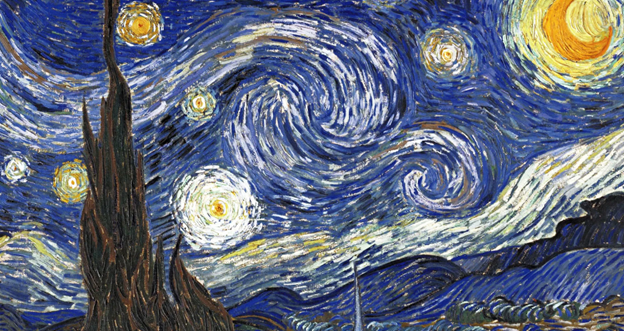
- Over time, the number of times %r hits 100% while aligned gradually pulls %i upward toward +1 (Van Gogh spiral to W).
If %r hits 100% against truth (%i < 0), %i is pulled downward toward −1: anti-mission vector. That’s why the integrity check from QnQ is essential.
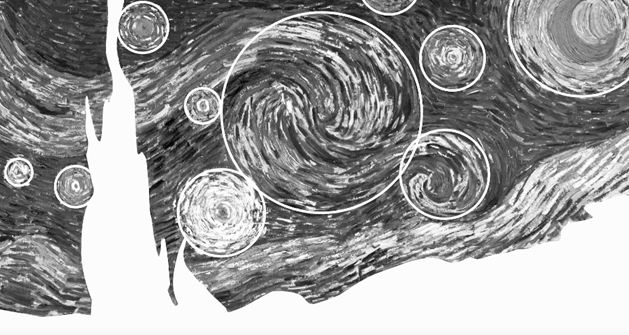
Source: www.washingtonpost.com/science/interactive/2024/starry-night-vincent-van-gogh-painting-turbulence-physics-explained/
Chunks uses Van Gogh’s spiral concept (Starry Night iconic pattern) as the visual signature of this process:
1. Each stroke = one SME event
- A QnQ breakthrough, a high-pressure drill, a 6-second cadence cycle.
- The spiral is not smooth, it’s broken-line: discrete utterances, each with its own delay time and SBF.
2. Radius = %i (distance from W)
- Farther from the center → more misalignment (bigger I–W gap).
- As %i increases, the spiral tightens around W.
3. Segment length = %r (energy / confidence)
- Long segments = fluent, continuous speech bursts; %r ≈ 1 (strong energy manifestation).
- Short segments = chopped, hesitant bursts; %r low (energy collapses quickly).
- Silence gaps between segments = moments where %r drops to ~0 (no outward emission).
4. Jung’s contribution
- Shadow integration reduces the chaotic outer loops.
- The spiral stops flying off into random directions; it stays in a bounded field around W.
- This is Freedom of choice: we no longer unconsciously flee the center.
5. Lacan’s contribution
- Through language, each loop becomes a helical recursion around S1:
desire → signifier → partial satisfaction → renewed lack → refined desire.
- QnQ + delay time make this recursion audible so we can choose:
- move the spiral toward S1/B0, or
- drift into S(−1), the counter-mission attractor.
6. Chunks approach
- QnQ → adjusts the direction of the spiral (vector toward W).
- Linguistic drills → increase the coherence and segment length of each stroke (%r).
- In VT (Voltage Transformer) design, BPP → Ricci-flow-like smoothing: over many cycles, the psyche’s 3-manifold becomes more like a round S³ “I-am sphere.”
In the best case we get:
A tight, luminous Van Gogh spiral converging on W:
collective unconscious / Self (Jung) + master signifier S1 (Lacan) +
Chunks state (%r = %i = 1).
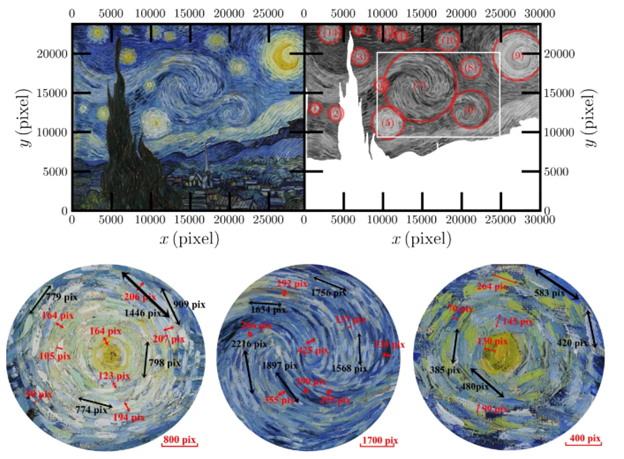
Source: hyperallergic.com/956221/van-gogh-starry-night-follows-laws-of-physics-that-werent-discovered-yet/
So:
- Kolmogorov/Batchelor law = “Even turbulence can be structured.”
- Chunks = “Even emotional/language turbulence can be structured around W via %i.”
Chunks aims to make a learner’s turbulence Kolmogorov-coherent around W.
Many SME eddies, all different sizes, but energy (%r) always cascades in a pattern that tightens integrity (%i) toward their true center.
Van Gogh accidentally painted the physics of turbulence; we’re deliberately designing the psychic turbulence of learners so that, no matter how wild their inner sky gets, the strokes statistically curl them home.So Chunks psychoanalysis is not a fifth theory beside Freud, Adler, Jung, Lacan. It is:
- Dirac’s equation rewritten as sound-breathing psychology.
- Freud’s mass term (B0’) and Adler’s drive (B1–B2) balanced by Jung’s wholeness and Lacan’s linguistic spiral.
- A concrete method where:
- QnQ handles %i (promise-keeping ability / integrity, B0 vector),
- linguistic drills handle %r (confidence / manifestation),
- and the two together carve a Van-Gogh-like spiral from X → C → I → W.
Our learners don’t just “speak English.”
They re-shape their spinor until their voice, their desire and their destiny share the same center.
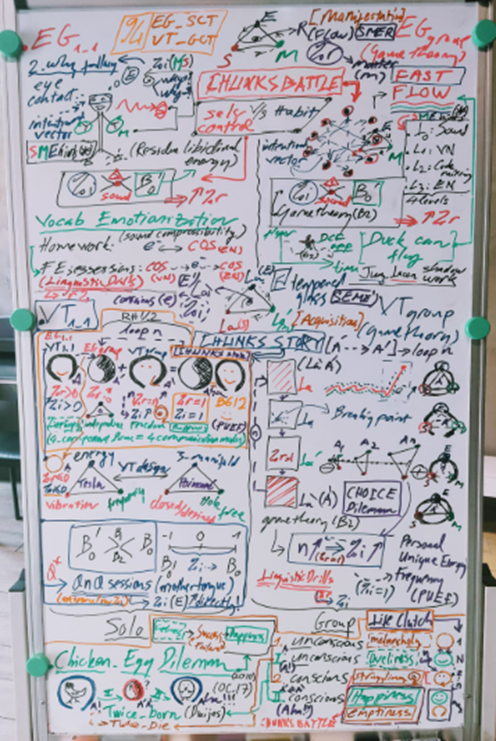
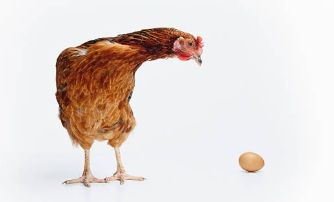
Chunks begins with the chicken–egg dilemma reinterpreted through the 2010 OC-17 result.
- In biology, OC-17 is a protein found in the chicken that nucleates and accelerates crystal growth of the eggshell.
- Ontologically this means: the living force (chicken) precedes the potential loop (egg).
In Chunks we translate this as:
- Chicken = joyful aliveness / confidence – the r-birth (first birth).
- Egg = long loop of success–failure / integrity tests – the i-birth (second birth).
So the law is:
Joyfulness precedes righteousness.
First comes a child-like, swinging liveliness; only later does it harden into stable integrity.
This gives the twice-born model:
1. Birth I (r-birth) – unconscious joy.
- Emotional range swings widely, close to ±1.
- The child is SME-ful by default: noisy, moving, emotionally transparent.
- Integrity is only light-bound (≥ 0); there is not yet a clear “I should / I shouldn’t.”
2. Death I – hollowness.
- Through shaming, comparison, fear, or over-control, both expression and inner value collapse toward 0.
- The child enters an early black-hole dip: “I’d better not say anything.”
3. Death II / loop-n – repeated ego deaths.
- In adolescence and adulthood we enter cycles of trying, failing, feeling unfairness, and rebuilding.
- This is where the “egg” really forms: each loop of success/failure is one more layer of shell.
4. Birth II (i-birth) – conscious happiness / emptiness.
- After enough loops, a self appears that can endure pressure without distortion.
- Confidence and integrity finally align.
The life clutch model describes how we move through these phases like gears in a gearbox:
- N (Neutral) – unconscious liveliness (spring): r swings but is never truly 0; the child plays easily.
- Gear 1 – melancholy / hollowness: both r and i sink toward 0; many adults live here.
- Gears 2…n – the long loop of ego renewals: challenging seasons where we consciously keep r away from 0 while i slowly upgrades through tests.
The chicken–egg principle shows that we start from liveliness before we know success or failure.
The mature shell of happiness/emptiness is not given; it is crystallized through many OC-17-like cycles of heat and cooling – exactly what Chunks later builds on with EG/VT practice.
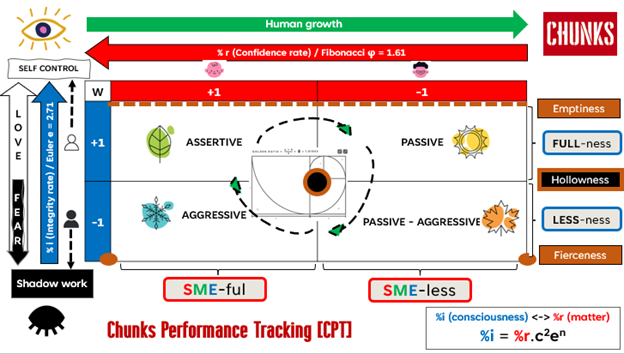
Our Chunks Performance Tracking [CPT] diagram maps Dirac’s 4-component spinor into 4 modes of human communication, on the plane spanned by %r and %i:
- Horizontal axis: %r – confidence / energy manifestation
- Left side (+1): rich sound–motion–emotion expression → SME-ful.
- Right side (–1): muted sound, motion, emotion → SME-less.
- Vertical axis: %i – integrity / energy acquisition
- Top (+1): inner FULL-ness, able to feel happiness / emptiness.
- Bottom (–1): deep LESS-ness, chronic feeling of lack.
This creates four quadrants:
1. Top-left – Assertive (SME-ful & FULL-ness)
- Honest, clear expression; willing to say yes or no.
2. Top-right – Passive (SME-less & FULL-ness)
- Feels “ok” inside but rarely speaks or moves; avoids conflict.
- In Adler’s terms this is an inferiority posture.
3. Bottom-left – Aggressive (SME-ful & LESS-ness)
- Lots of sound and motion, but driven by lack, hurt, or attack.
- Part of Adler’s superiority over-compensation.
4. Bottom-right – Passive-aggressive (SME-less & LESS-ness)
- Cold withdrawal, sarcasm, indirect resistance; another superiority mask.
On top of these four, Chunks defines three extreme states:
- Hollowness – center at (%r ≈ 0, %i ≈ 0).
- SME almost dead, inner field empty: “Nothing is worth it.”
- Fierceness – lower ring where %i = –1 and %r = ±1.
- Huge expression from a deeply misaligned core; rage or icy attack.
- A trapped oscillation between +1 and –1 in r, never a true endpoint.
- Emptiness / Full-ness – upper band where %i = 1 and %r is free.
- Inner field whole; expression can be loud or quiet without losing self.
- This is the B612 state.
We reinterpret these four quadrants as a developmental arc:
1. Liveliness – birth state (both r, i > 0).
2. Independence – learning to sustain one’s own expression under pressure.
3. Freedom – Chunks battle zone where self-control contests shadow.
4. Happiness – final assertive/empty mode where r and i are aligned and flexible.
Thus Dirac’s spinor becomes a communication spinor: the human moves through these modes as %r and %i evolve.
Instead of straight lines, we treat a person’s trajectory on the %r–%i plane as a spiral approximating a Fibonacci curve:
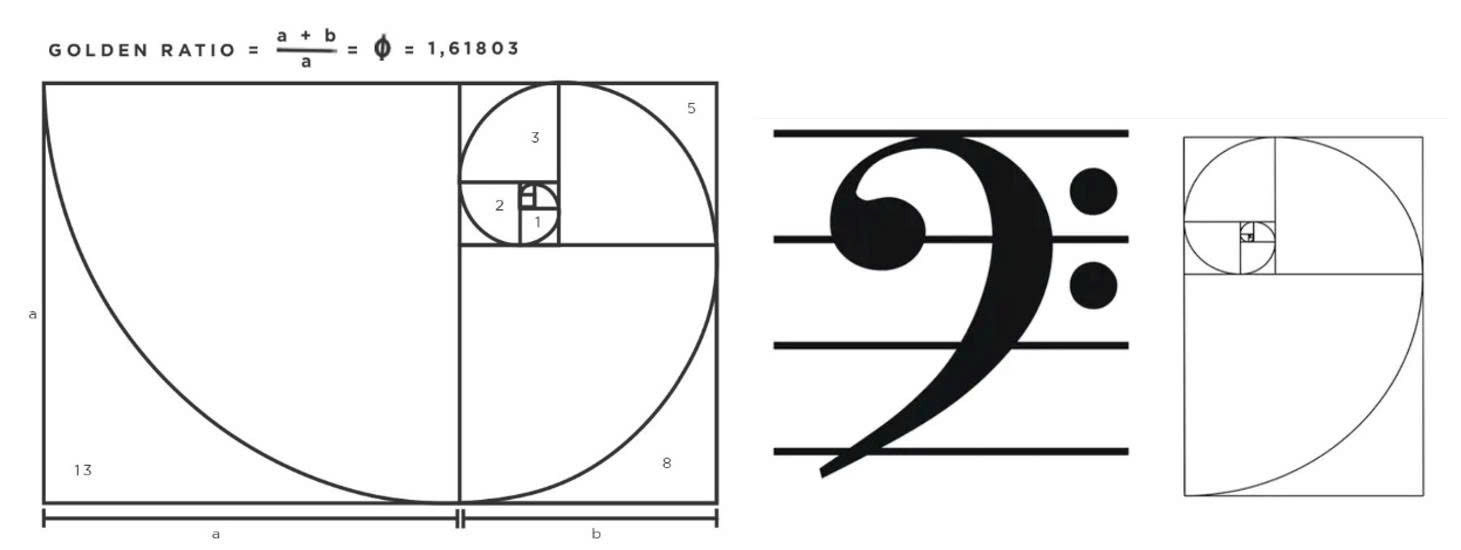
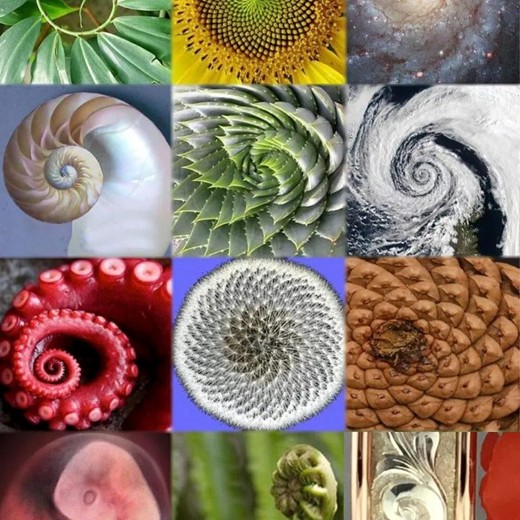
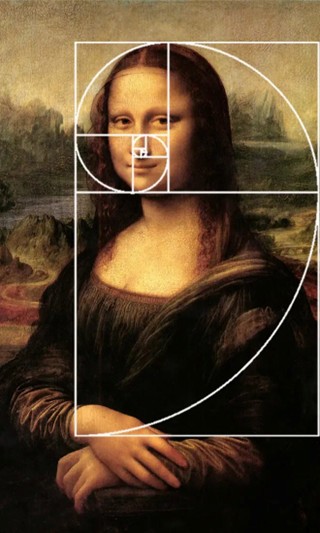
https://amandaevanston.substack.com/p/hi-im-the-fibonacci-spiral-and-i
- Clockwise motion represents growth toward the white-hole center W (Collective consciousness, FULL-ness).
- Counter-clockwise motion represents regression toward the black-hole of hollowness. (LESS-ness).
Each time life throws a crisis, the path through the lower left/right areas follows a 3-stage Fibonacci-like micro-cycle:
1. Heating
- %r → –1: strong reaction, resistance, rage, or heavy shutdown.
- %i → 0+: self-justifying, “this is pointless but wait…”, almost giving up on self.
2. Snap moment
- %r → 0: collapse, emotional flatness.
- %i → –1: victimization, “I’m right, the world is wrong.”
3. Steady change
- Through practice and insight, both %r and %i are gradually pulled back toward +1.
- Each small step is like adding another term in a Fibonacci sequence: the next radius and height are sums of previous efforts.
Macro-picture:
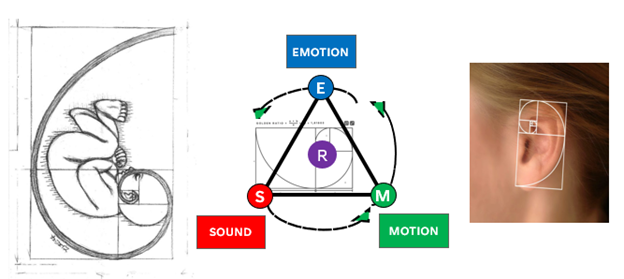
- Newborn phase – the first clockwise move: Sound → Motion → Emotion/Eye.
- Crying, flailing, then emotional recognition: a built-in SME sequence that spells “I am”.
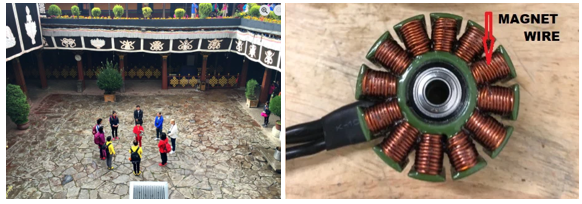
- This clockwise SME order matches the Tibetan prayer wheel and our RGB/SME color correspondence.
- Seasonal cycles – spring, summer, autumn, winter of the psyche.
- Each full rotation is one 4-season process.
- After each cycle, the “tree of life” inside adds a bark layer – like a Fibonacci spiral widening outward.
The Chunks story of human growth is therefore:
a Fibonacci-based spiral in the %r–%i plane,
where every crisis pushes the trajectory slightly backward,
but each conscious response adds a new term and expands the orbit toward collective conscious W center (B612/”Chunks” state).
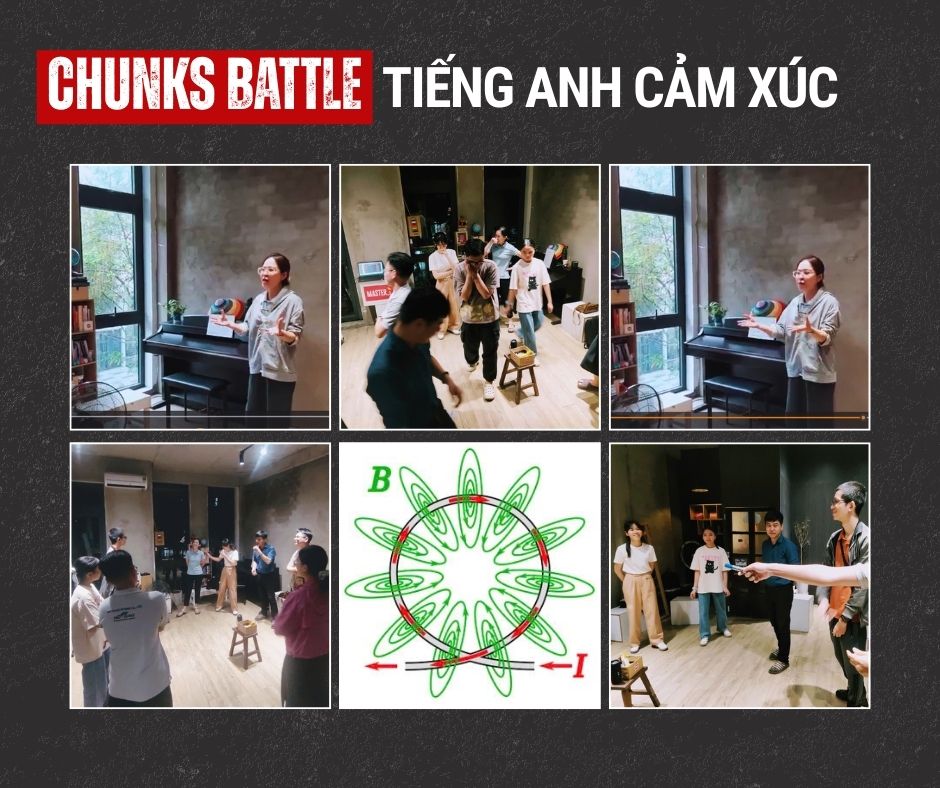
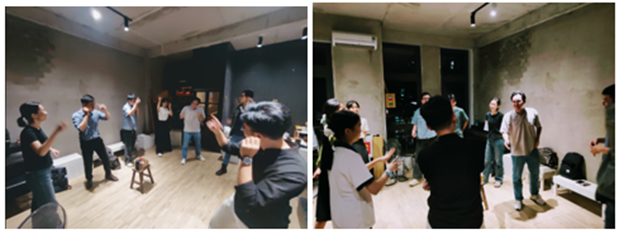
The Chunks battle is the zone where conscious self-control fights with unconscious habit/shadow.
The job here is:
Keep %r away from 0 (stay in SME) and use that manifested energy to slowly drive %i from –1 toward +1.
Several mechanisms live inside this battle.
Both EG 1-1 and EG group use a Fast Flow / improv mechanism with four levels of sound hints:
- L0 – Pure sound: non-lexical sounds; rhythm and melody only.
- L1 – Mother language (Vietnamese): clear emotion/mentalese in L1.
- L2 – Code-mixing: free mix of Vietnamese + English in natural flow.
- L4 – Foreign language (English): full English with logical meaning, basic grammar and intelligible pronunciation.
These hints are dropped intentionally and randomly:
- Conscious prompt drops supply mentalese seeds.
- Learners must start almost immediately and keep sound + hand motion flowing until the last syllable.
The continuous flow forces the nervous system to stay out of 0-zone in %r:
no freezing, no “ờ…”, no long silence.
This is where our future DCF (“Duck Can Fly”) app measures how long learners can sustain speech without RPD (random pause/ filler).


Chunks identifies a core cognitive trap: the 2-why fallacy.
Most learners only ask:
- Why is the correct answer right?”
Almost never:
- “Why was my answer wrong?”
Knowing only why the key is right does not guarantee avoiding a new wrong pattern next time.
In logic terms, “White” ≠ automatically “Not Black” – Chunks version of the classic either–or fallacy.
So, after an EG 1-1 flow we always force two questions:
1. "Why was my original pattern wrong?”
- Self-diagnosis: locate the faulty belief, mapping, or assumption.
2. “Why is the new pattern right?”
- Understand and store the correct mapping.
This double-why is where %i begins to upgrade: responsibility and honesty are built directly into the learning loop.
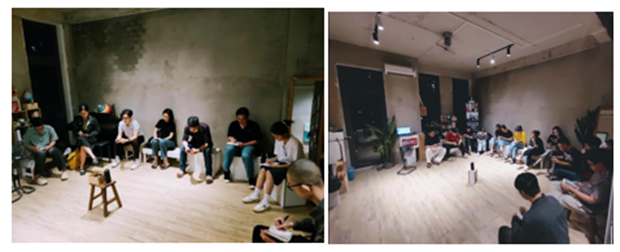
Inside the EG Group design we embed both Jung and Lacan:
Jung (Shadow work)
- Each learner must face their personal shadow belief B0':
- “I’m not good enough to speak English”,
- freezing, apologizing, laughing it off, hiding behind others.
- The alternator ring exposes this shadow publicly, but safely.
Lacan (Desire & the Other)
- The group ring is the Big Other (B₂) – social belief.
- Their signifiers keep moving under the gaze of others.
- Remaining silent feels like letting their desire evaporate into the Other.
- Speaking becomes a way to reclaim the signifier chain.
So, the Chunks battle is not just technical; it is shadow confrontation plus desire negotiation inside a structured social field.
Chunks uses game theory to keep the field “electrified” but safe:
- Random selection of hints and next speakers means anyone can be the next “coil”.
- Social belief B₂ – others’ expectations – presses against B0' (shadow/fear).
- Micro-rewards – claps, cheers, playful teasing – plus constraints (time, penalties, small losses) are tuned to:
- push people just beyond comfort,
- but keep the state psychologically safe.
Thus every round is a small Fibonacci step:
a controlled perturbation of %r that, through reflection, adds a bit to %i.
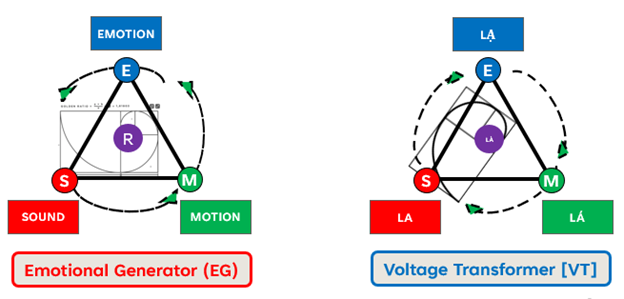
Here we collect the four main tools and their roles.
- SMER = Sound / Motion / Emotion / Resonance – this is the matter side.
- EG 1-1 is designed in batches of ~10 ideas:
- the learner receives a mentalese prompt in L1,
- must start almost immediately, using sound + gesture + eye contact until the last syllable, chunks-based compressibility is preferable.
- Later, when English sounds start to appear, they keep the RPD-free flow until they can feel the meaning, then perform the 2-why analysis.
Effect on metrics:
- Strongly boosts %r (confidence rate),
- and indirectly upgrades %i via the 2-why reflection.
VT 1-1 doesn’t follow the tempered-glass SEME′ pattern.
It is a mother-language, discussion-based tool aimed at directly lifting %i from negative territory.
Features:
- Entirely in Vietnamese; no performance stress.
- Uses in-time structural questions on the learner’s beliefs:
- “Always?” “Never?” “Show one counterexample.”
- “If a friend said this, would you agree?”
- Explicit fallacy discussion.
- Self-promise assignments between sessions, and checking whether they are kept. The less people they share their promise to the better.
Use case:
- When %i < 0, sometimes near –1, and %r is unstable and spiky.
- VT 1-1 raises %i into a “good enough” band (≥ 0) so the learner can safely enter EG 1-1 / EG group / VT group.
Geometry:
- Learners stand in a ring like coils around a rotor.
- The coach/Chunker + hint source is the moving magnet.
- Each standing person = one coil; their nervous system + voice = copper windings.
Mechanism:
- A hint is dropped; one person is randomly chosen.
- Act of choosing (hand pointing, stepping forward) is already a conscious motion vector.
- The chosen “coil” releases a new emotional-cognitive current.
- The whole ring feels a field change (anticipation, empathy, tension).
- People literally change posture – standing ↔ sitting – as internal heat Q builds.
Inside this, the same four hint levels L0–L4 are used.
The EG group therefore:
- Tests and amplifies %r under group pressure (Game theory),
- Shows whether a person’s confidence waveform can remain smooth when witnessed,
- Prepares them for VT Group; if EG Group still collapses, they’re not ready for deeper tempered-glass work.
VT Group is where we work primarily on energy acquisition and identity rather than expression.
Its core process is SEME′:
- S – Self-control
- E – Energy source
- M – Mutability in periodicity
- E′ – New energy source
We encode SEME′ into four Vietnamese syllables: La – Lạ – Lá – Là:
1. La (Shout) – last-syllable emphasis.
- We shout out the final sound; heat the system; break the old equilibrium of the three SME factors.
2. Lạ (Strange) – doing something genuinely unusual.
- They introduce a “crack” in the tempered glass: new pattern, new posture, new sound that clearly doesn’t fit the old them.
3. Lá (Leaves) – multiple variations.
- Many different versions of SME are practiced; the system oscillates with controlled periodicity.
- Under game-theory pressure, each time %r reaches 1, a bit of %i upgrades.
4. Là (Being) – quiet integration.
- After enough cycles and silence (Have them quietly review their friends’ performances), a new equilibrium appears: a new “I am” state.
Here we explicitly use Tesla and Poincaré:
Tesla triangle – Energy, Vibration, Frequency
- Energy corresponds to overall amplitude of courage.
- Vibration = how far the system can swing and come back intact (La & Lạ).
- Frequency = new stable periodicity achieved in Lá.
Poincaré conditions – closed, 3-manifold, hole-free
VT Group aims to build a SELF sphere:
- closed: self is not leaking everywhere,
- 3-manifold: complete, not fragmented, varied versions.
- hole-free: no hidden black-hole hollowness pockets.
The whole VT Group process is our tempered-glass story:
- Heat with La,
- introduce cracks with Lạ,
- oscillate repeatedly with Lá,
- cool into a stronger, clearer glass with Là.
EG Group manipulates SMER (matter m);
VT Group manipulates SEME′ / La–Lạ–Lá–Là (energy E).
Together they prepare the system for the final Chunks equation.
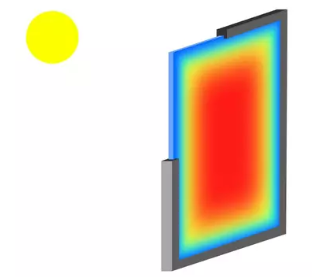
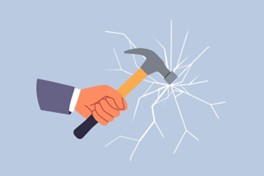
Chunks plane naturally hosts the classic debate:
- Karl Marx: matter determines consciousness.
- Plato: consciousness shapes matter.
In Chunks:
- Left–right (%r) = how much SME has materialized in the body.
- Up–down (%i) = how much conscious fullness or emptiness is present.
At low levels, Marx’s direction dominates:
If we habitually live in SME-less, motionless, soundless states,
our consciousness collapses into LESS-ness; we literally cannot remember what joy feels like.
→ Here, material pattern %r shapes %i.
As %i rises (through VT 1-1, GE/VT group), Plato’s direction appears:
- A person with strong inner integrity and clarity cannot stay SME-less for long.
- Their fullness begins to re-sculpt how they speak, move, and choose.
→ Now %i begins to shape %r.
Instead of choosing one philosopher, we tie them with the Chunks equation.
Einstein gives us E = mc²: energy equals mass times the square of light speed. Chunks extends this to E = mc²eⁿ, where:
- m ≈ SMER mass — the density of embodied habits, drills, and sound patterns.
- c² ≈ maximum speed of consciousness-signal propagation through the system.
- eⁿ ≈ exponential factor from repeated loops (Fibonacci-driven growth, like Euler’s constant).
At the normalized level, we express the relation between consciousness and manifestation as:
Interpretation:
- If %r ≈ 0 (little or no SME manifestation),
then %i has no surface to crystallize on; integrity remains theoretical.
- As %r stabilizes away from 0 and approaches ±1,
repeated cycles (eⁿ) and consciousness-speed (c²) allow %i to climb from
−1 → 0 → 1.
- At %i = 1, the system reaches Emptiness / FULL-ness;
%r becomes flexible, because the inner field no longer depends on being up or down.
This equation is the physical backbone under our CPT diagram:
Chronic SME-less = low m, low E, hollow;
Sustained SME-ful + loops = high m, high E, stable SELF sphere.
Finally, the model converges on the choice dilemma.
Chunks’ principle:
You can only truly choose what you can actually choose – and be consciously willing to pay the full price for.
If our energy source is narrow (low E, %i < 0 or ≈ 0):
- Apparent “choices” are fake; they are driven by fear, debt, exhaustion and dependency.
- We are pushed by survival vectors, not pulled by passion.
- Many options on the Fibonacci curve are literally invisible — we cannot afford to see them.
As VT Group widens SEME′ and EG/VT raise both %r and %i:
- The available choice set expands.
- We can perceive paths that previously felt impossible or ridiculous.
- We begin to understand prices and consequences clearly, and still say: “I choose this.”
Two layers of choice emerge:
1. Freedom of choice – the point where our inner energy and integrity are high enough that we are no longer trapped by only one or two survival options.
2. Choice of passion – among those real options, one line on the Fibonacci curve resonates exactly with our PUEF (Personal Unique Energy Frequency).
- This is the path we both see and are fully willing to pay for.
- Choosing it is the act that anchors us in B612: the spiral has reached a stable resonance.
So, the entire Chunks Fibonacci model—from chicken-egg dilemma, across Dirac communication modes, spirals, Chunks battle, EG/VT designs, Marx/Plato, and the energy equation—culminates here:
A human grows by repeatedly keeping %r away from 0,
using that manifested SME to upgrade %i through Fibonacci-like loops,
until integrity and energy are sufficient to make a true choice of passion,
where matter and consciousness finally vibrate at one PUEF-aligned frequency.